Written by Gediminas Vengrauskas, licensed Coastal Skipper · ICC · VHF. Updated November 2026
The short answer
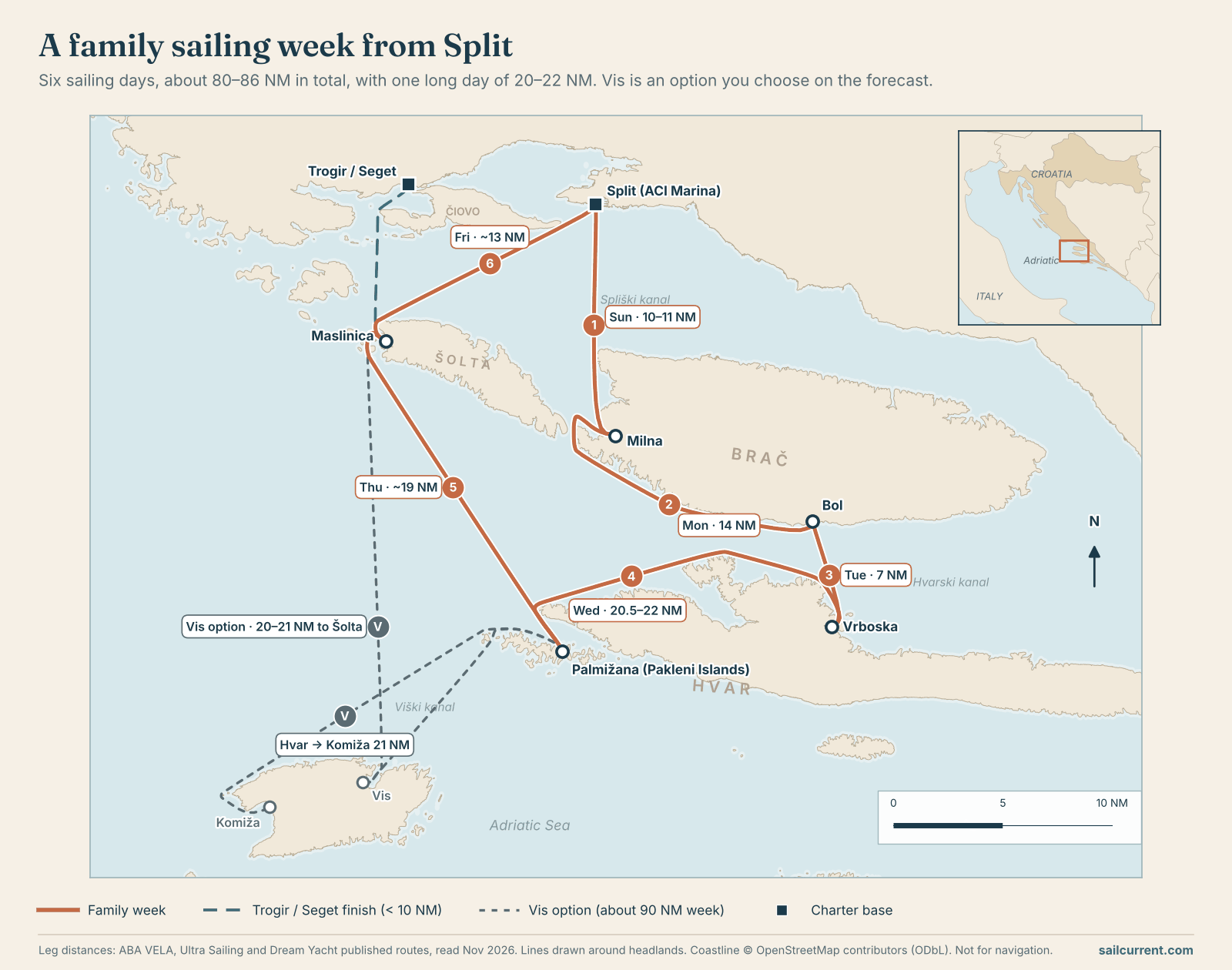
A gentle family week from Split is six sailing days around the three islands closest to the city: Brač, Hvar and Šolta. Milna on Brač first, then Bol on Brač's south coast, a short hop to Vrboska on Hvar, the Pakleni Islands off Hvar town, and Šolta on the way home. On the distances local fleets publish, plus my own estimate for the one leg nobody publishes, that is about 80-86 nautical miles, with one long day of 20-22. At the 5-knot average I plan with, it comes to roughly two and three-quarter hours under way a day.
It is a bigger week than the one I planned from Lefkada for the Ionian. The islands are further apart and the afternoon wind has more to say. That is why, with a family, I would sail it on a catamaran, start every day early, and treat Vis as an option you choose on the forecast, not a promise you make when booking.
Key takeaways
Split-area fleets sit in three places: ACI Marina Split in the city, Marina Baotić at Seget next to Trogir, and Marina Agana further west. Where your boat is decides your first and last leg.
Boarding is in the afternoon (15:00 at The Moorings in Agana, 17:00 at the Seget fleets), and the boat goes back the evening before you fly.
The summer maestral usually starts around 9-10 am and peaks around 2 pm, according to The Moorings. Sail in the morning, swim in the afternoon.
Vis and the Blue Cave are worth it, but they add open-water legs of about 20 NM. With small children, decide on the day.
Where does a sailing week from Split actually start?
At one of three marinas, and they are not all in Split. ABA VELA, a Split charter company, keeps its yachts at Pier D in ACI Marina Split, in the city itself. Dream Yacht Charter and Ultra Sailing work from Marina Baotić at Seget Donji, next to Trogir, which Dream Yacht puts 9 km and about 15 minutes from Split airport. The Moorings is at Marina Agana, about 30 minutes from the airport. Ultra Sailing says its Trogir base moves to SCT Marina Trogir from the 2027 season.
A Trogir or Seget boat is closer to Šolta, a city-marina boat closer to Brač. The plan below starts and ends in Split, and I note where a Trogir start changes the numbers.
What does the week look like at a glance?
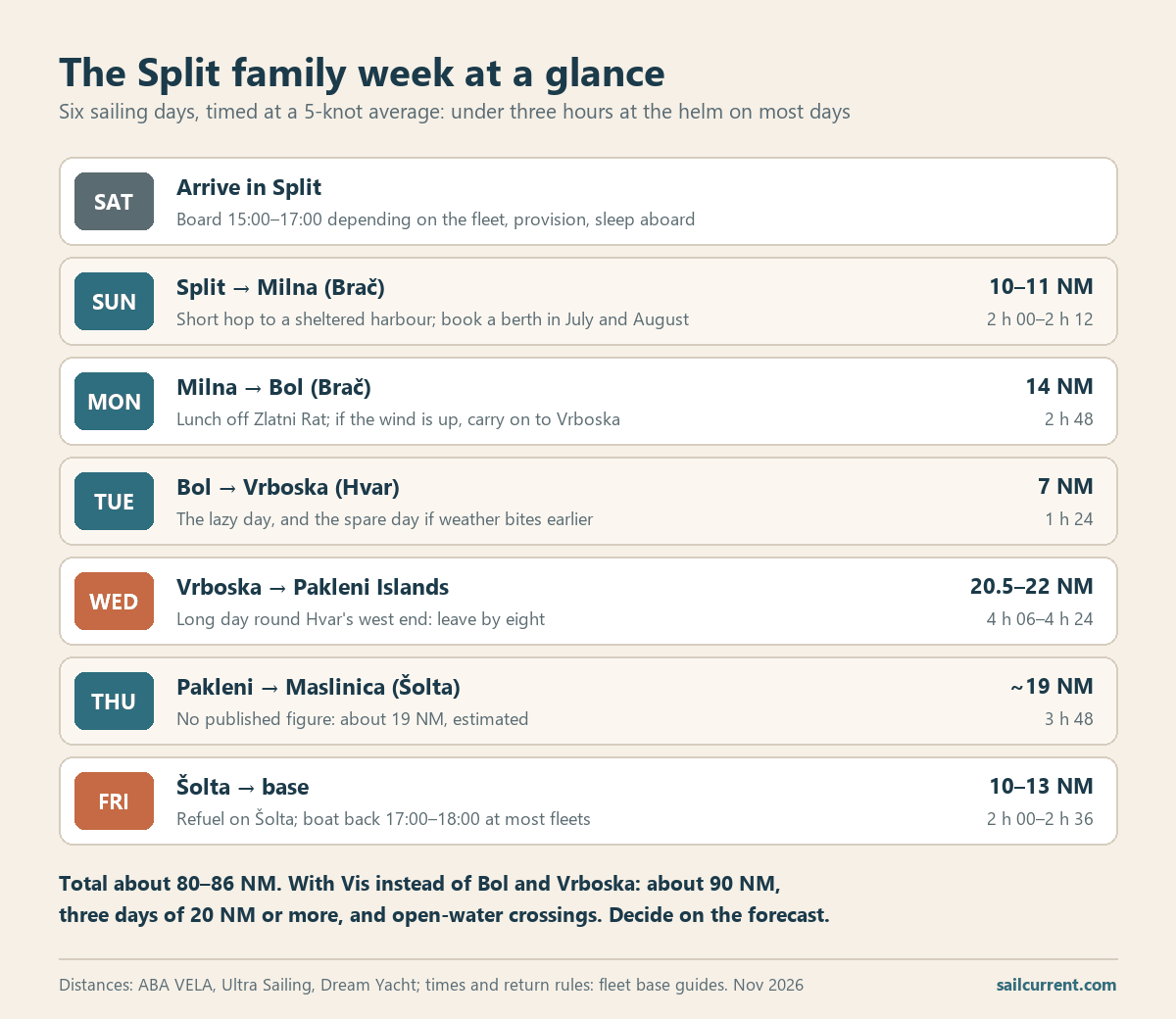
Six sailing days, Sunday to Friday, after a Saturday night aboard. Here is the family version, with the distances local charter companies publish and the time at a steady 5 knots:
Saturday: fly to Split, board in the afternoon, provision, sleep aboard.
Sunday: Split to Milna (Brač), 10-11 NM, about 2 h 10 min.
Monday: Milna to Bol (Brač), 14 NM, about 2 h 50 min.
Tuesday: Bol to Vrboska (Hvar), 7 NM, under 1 h 30 min. The lazy day.
Wednesday: Vrboska to the Pakleni Islands, 20-22 NM, about 4 h 10 min to 4 h 25 min. The long day.
Thursday: Pakleni Islands to Maslinica (Šolta), about 19 NM, about 3 h 50 min.
Friday: Šolta back to the base, about 10-13 NM, 2 to 2 h 40 min.
The total is about 80-86 NM, depending on whose figures you take and where your boat lives: under three hours at the helm on an average day, with the long day in mid-week, once everyone has found their sea legs.
Saturday: why not sail on the first evening?
Because boarding is late afternoon, and Croatian charter rules want you tied up well before dark. The Moorings boards at 15:00 in Agana; Dream Yacht and Ultra Sailing board from 17:00 at Seget. ABA VELA's own loop does leave the city marina around 17:00 for Milna, and it can be done. But The Moorings' base guide is plain that night sailing is not permitted and that you should be moored at least an hour before sunset, so there is no slack if check-in runs long.
With children, I would use Saturday for the briefing, the shopping and an early night. Two practical notes from the base guides: Dream Yacht's Seget base offers no provisioning service, so plan the supermarket run; and The Moorings says it has very few children's life jackets and limited children's fins, so bring your own. How meals and cabins work with a skipper aboard is in what it is like having a skipper on board.
Sunday: Split to Milna, 10-11 NM
A short first hop across the channel to the west end of Brač, into one of the best-sheltered harbours in the area. ABA VELA gives the leg as 10 NM and Ultra Sailing as 11. Orvas Yachting calls Milna a protected harbour, and Ultra counts about 170 berths across the ACI marina and two private ones.
In July and August that is not plenty: ABA VELA suggests booking a berth through the My Sea app, and I would do it the evening before.
Monday: Milna to Bol, 14 NM
Along Brač's south coast to Zlatni Rat, the best-known beach in the area. ABA VELA gives Milna to Bol as 14 NM and suggests anchoring or taking a buoy off Zlatni Rat, then a mooring line at the Bol promenade. It also says, fairly, that Bol is known for its nightlife and for windy conditions. Zlatni Rat itself is a pebble spit that shifts with the wind and waves, and Bol is a windsurfing town for a reason.
So I plan Monday as a lunch stop off the beach, and decide on the night at lunchtime. If the afternoon wind is up, ABA VELA's alternative is to carry on 7 NM across to Vrboska on Hvar before sunset. With children aboard, a quiet night beats a lively one.
Tuesday: Bol to Vrboska, the lazy day
The shortest hop of the week, 7 NM across the channel to Hvar's north coast. Vrboska is a small harbour village with fishing-harbour origins, and ABA VELA notes a mooring line is available there. At neighbouring Jelsa, The Moorings says anchoring in Jelsa bay itself is not allowed, but the town quay has laid moorings all the way round. On a family week I always build in one day like this, and if the weather costs you a day earlier in the week, this is the day you get back.
Wednesday: Vrboska to the Pakleni Islands, 20-22 NM
The longest day, and the one I would start earliest. ABA VELA gives Vrboska to Hvar as 22 NM and Ultra Sailing gives Jelsa to Palmižana as 20.5. In a straight line it is under 13 NM, but the boat has to go round the west end of Hvar, so the chart flatters you. At 5 knots, call it four and a quarter hours.
The reward is the Pakleni Islands, the chain of small islands just off Hvar town. The town promenade is hard to get, ABA VELA warns, because large yachts book it days ahead. The calmer option is ACI Marina Palmižana on Sveti Klement, the largest Pakleni island, with a taxi boat into Hvar in about 15 minutes. The Moorings lists plenty of anchorages among the islands too. Leave Vrboska by eight, and you will be through the open stretch before the afternoon wind builds.
Thursday: Pakleni Islands to Šolta, about 19 NM
This is the one leg on the route that none of the fleets I read publishes in miles, so here is how I estimate it. Dream Yacht's crewed Trogir cruise sails the reverse, Maslinica to Palmižana, in 2 hours 45 minutes, and its page says its times assume a 7-knot average. That works out at about 19 NM. The straight line on the published coordinates is just under 16, so 19 for the sailed route is believable. At 5 knots it is about three hours fifty.
Maslinica sits at the west end of Šolta. The Moorings says you can tie up at the pier in the harbour or anchor in the bay of Šešula next door, and ABA VELA suggests arriving by lunchtime and taking a buoy in Šešula if the harbour is full. For the last night of the holiday, a quiet island village is exactly right.
Friday: Šolta to the base, and the return-time rule
The last leg is short, but it has a deadline, and the fuel queue is part of it. Dream Yacht gives Trogir to Maslinica as a little under 10 NM. For the city marina I have no published figure from Maslinica; the straight line is about 12 NM, so I plan on 13. Ultra Sailing's route comes home from Stomorska, on Šolta's north coast, which it gives as 8 NM from Split.
Every fleet wants the boat back the evening before you leave. The Moorings asks for 18:00 at Agana, with disembarkation at 09:00 next morning. Dream Yacht at Seget wants your last night spent in the marina, arrival before 17:00, and the boat handed back at 09:00 on Saturday with a full tank. ABA VELA suggests refuelling at Rogač on Šolta because of the long diesel queues at the Split harbour station. I would take that advice.
What about Vis and the Blue Cave?
Vis is my favourite kind of island, and it is also the most exposed one on this route. It sits out in open water, and the published legs to it are all around 20 NM: Hvar to Komiža 21 (ABA VELA), Vis to Maslinica 20 (ABA VELA), Vis to Stomorska 21 (Ultra Sailing). Orvas Yachting notes the port of Vis has low protection against stronger winds, and that Komiža is exposed to the west and south-west.
To fit it into a family week, swap Bol and Vrboska for a direct run Milna to Jelsa (20 NM in Ultra Sailing's figures), then Pakleni, then Vis, then Šolta. That makes the week about 90 NM with three days of 20 or more. With teenagers or a crew that has sailed before, it is a lovely week. With small children, I keep it as plan B and decide on Tuesday evening, when the forecast for the rest of the week is clear.
The Blue Cave on Biševo, a few miles from Komiža, is the reason most families ask about Vis. Orvas says entry is by small rowing boat only, and only in quiet, waveless weather. The Moorings says the light is best between 11 am and 1 pm, and that you should take a buoy on Biševo's east side and wait for an official dinghy: going in alone earns a fine. ABA VELA adds that you get a receipt with a waiting-list number. In Komiža itself, The Moorings advises being on a buoy before 4 pm, and calls Vis town's quay the busiest in Croatia in high season.
How does the wind shape a Croatian week?
Mostly through the maestral, a summer sea breeze that is light in the morning and fresh by mid-afternoon. The Moorings' Agana guide says it usually starts between 9 and 10 am, peaks around 2 pm at about 16-20 knots, and dies away before sunset. That one sentence explains the whole plan: sail in the morning, arrive by early afternoon, swim and eat while it blows.
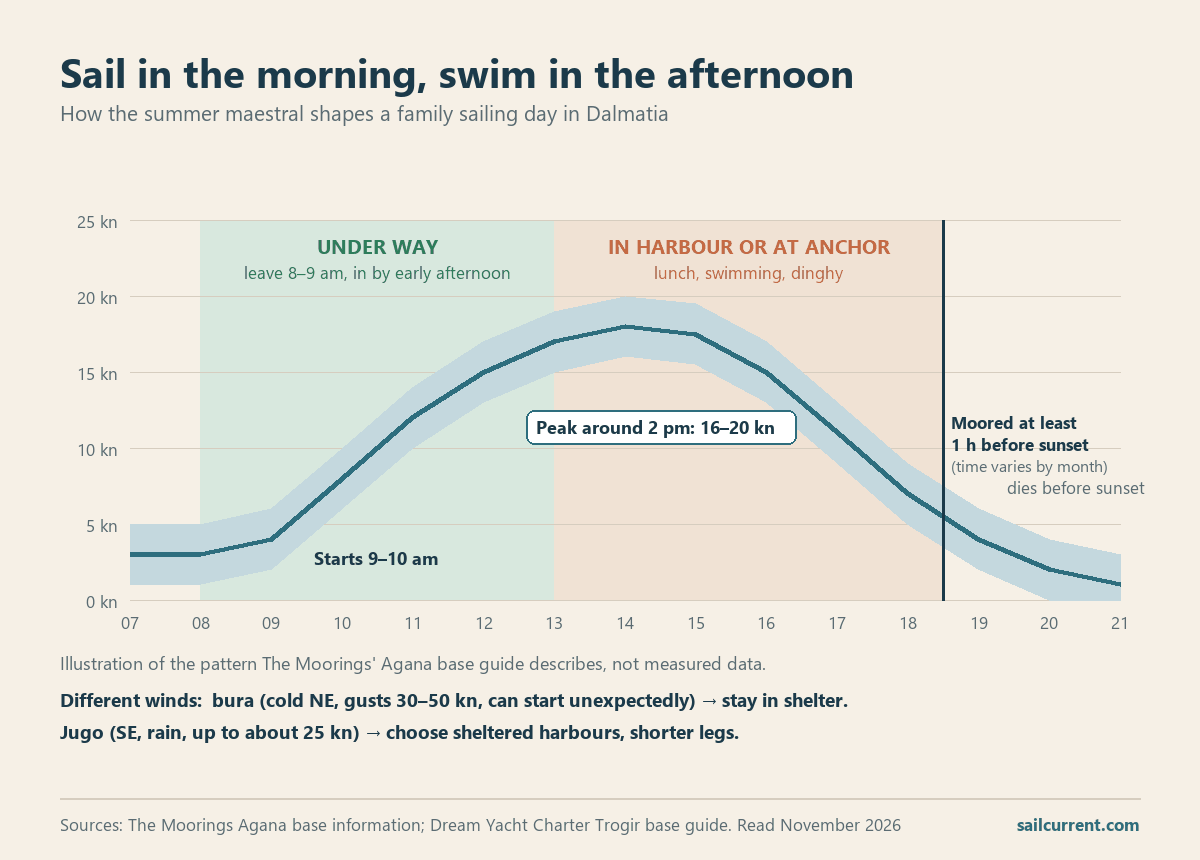
The two winds to respect are different. The bura is a cold north-easterly that comes in strong gusts and, as The Moorings puts it, can begin unexpectedly; Dream Yacht's Trogir guide gives its gusts as 30-50 knots and says to find a sheltered anchorage if it is forecast. The jugo, or sirocco, blows from the south-east with rain and rough seas, up to about 25 knots in Dream Yacht's guide. Dream Yacht lists the VHF weather broadcasts at 06:20, 13:20 and 22:20; I decide each day after the first one. The Greek side of the same question is in my month-by-month wind guide.
What do moorings cost, and why does a catamaran pay more?
Buoys and marinas charge by boat size, and a catamaran counts as a big boat. The Moorings explains the system clearly. Buoys are either owned by a restaurant, where you are expected to eat, or run under a concession, where you pay for the night. Anchoring within 300 metres of concession buoys or a harbour costs the same as a buoy. Town quays are cheaper, cannot be reserved, and take cash only. And, in its words, "for catamarans the prices are always +50 or 80% of the listed price".So budget for a paid mooring most nights and carry cash. The tourist tax is charged with the charter booking at The Moorings, so it should not be a surprise on board. The weekly figures for a Croatian charter, fuel and harbours are on my Croatia charters page, and the deposit side is in charter security deposits in Greece and Croatia.
Why sail this week on a catamaran?
Because it sits flat, it gives children space, and it keeps everyone's cabins well apart. A catamaran does not heel under sail, which matters on the Wednesday and Thursday legs when the breeze is up, and it has room on deck and in the saloon for a family to spread out on a lazy afternoon. Catamarans are my own priority for 2027; I have skippered a Lagoon 42 and a Bali Catspace.
The honest downside is cost: the charter, the moorings and the end cleaning all run higher. I compared the two boat types line by line in catamaran or monohull for a skippered week. The figures there are Greek, but the trade-off is the same in Croatia.
Croatia or the Ionian for a first family week?
If your children are small and nobody has sailed before, the Ionian is gentler. If they are a bit older, Croatia gives you more. My Ionian week from Lefkada is about 77-80 NM with no leg longer than 18. This Split week is a little longer overall and has one day over 20. Neither is hard; one is softer.
What Croatia adds is towns. Split, Hvar, Vis and Trogir have a depth of history and life that the small Ionian villages do not try to match. With confident swimmers or teenagers aboard, I would choose Croatia without hesitation.
Can you skipper a boat in Croatia, and how does booking work?
Yes, on the same terms as in Greece: you charter the boat, and you hire me directly as your skipper. My certificates are on Croatia's table of recognised foreign certificates for bareboat-chartered yachts up to 30 GT. I do not own a fleet; the boat comes from a licensed charter company, and I sail it for you.
My weekly fee, what it covers and my 2027 dates are on the hire a captain page. The fee includes my travel to Athens, Split or Trogir, which covers ACI Marina Split and Marina Baotić; for any other base, such as Marina Agana, travel is at cost and agreed before you book. If someone in your group would rather skipper themselves, the licence side is covered in do you need a licence to charter a boat.
FAQ
How many nautical miles is a 7-day sailing loop from Split?
The gentle family version in this guide is about 80-86 NM over six sailing days. With Vis added it is about 90. Local fleets' classic loops are longer: Ultra Sailing's is 116 NM and ABA VELA's 132.
How many hours a day will we actually sail?
At a 5-knot average, under three hours on a typical day. The long day, round Hvar to the Pakleni Islands, is about four and a quarter hours. The lazy day to Vrboska is under an hour and a half.
What time do we board and return the boat?
It depends on the fleet. The Moorings boards at 15:00 at Agana and wants the boat back by 18:00 the evening before you leave. The Seget fleets board from 17:00, want your last night in the marina with arrival before 17:00, and hand over at 09:00 on Saturday.
Can we visit the Blue Cave with children?
Yes, in calm weather. Entry is by the official small boats only, so you take a buoy on Biševo's east side and wait for a dinghy; going in alone earns a fine. The light is best between 11 am and 1 pm, and visits happen only in calm, waveless weather.
Do we need to book berths in advance?
In July and August, yes, for the popular harbours. Milna can be booked through the My Sea app, the Hvar town promenade is the hardest berth on the route, and Komiža's buoys fill by about 4 pm.
Why does a catamaran pay more for moorings?
Buoys and marinas charge by size, and a catamaran is wide. The Moorings says catamarans pay 50 or 80% more than the listed price.
Is Croatia or the Ionian better for small children?
The Ionian is gentler: shorter hops and more sheltered water. Croatia suits confident swimmers and older children, and gives you more towns to explore.
Are 2027 weeks in Croatia still available?
Yes, 2027 dates are open. Tell me your preferred week and the size of your group and I will come back to you within 24 hours.
About the author
I am Gediminas Vengrauskas, a Lithuanian captain with six years of sailing and about 1,000 nautical miles logged. I hold a Coastal Skipper international certificate for sail and motor vessels up to 24 metres, day and night, up to 12 miles offshore, plus an ICC, a VHF radio certificate and a 2026 first-aid certificate. The waters I know best are Dalmatia and the Saronic Gulf, plus the Baltic, and the areas I offer are Dalmatia in Croatia and the Saronic, the Cyclades and the Ionian in Greece. I do not own a fleet; your boat comes from a licensed partner charter company, and I skipper it.
Planning a week in Croatia?
Send me your dates, your crew and what you would like the week to feel like, through the contact form. I reply within 24 hours.
Sources checked November 2026: ABA VELA's published Split routes and base page; Ultra Sailing's Central Dalmatia route and Trogir base page; The Moorings' Agana base information and itinerary; Dream Yacht Charter's Trogir base guide and Dalmatian cruise itinerary; Orvas Yachting's Split route notes.
