Written by Gediminas Vengrauskas, licensed Coastal Skipper · ICC · VHF. Updated November 2026
The short answer
Force 4 is the wind charter yachts are built for, Force 5 is lively sailing with a reef in, and Force 6 is where the sea, not the wind, starts running the day. On the Beaufort scale published by the UK Met Office, Force 4 is 11–16 knots with a probable wave of about 1 metre, Force 5 is 17–21 knots and 2 metres, and Force 6 is 22–27 knots and 3 metres, a sea it officially calls rough.
The numbers climb faster than they look. The push of the wind grows with the square of its speed, so a mid-Force 6 breeze presses on the sails more than three times as hard as a mid-Force 4. And the same forecast can feel like two different days, depending on which way you are heading and how much open water lies upwind of you. This guide covers what each force does to the motion, the noise, the galley and your sleep, and how a skipper reads the forecast before deciding where the boat goes.
Key takeaways
A Beaufort number describes the mean wind, averaged over ten minutes. Gusts are measured separately, as the strongest three-second burst, and can be considerably stronger.
The wave heights in the Beaufort table describe a fully developed open sea. Behind an island, the same wind builds far less sea.
Direction changes everything. In a forecast of 18 knots, a yacht beating upwind at 6 knots feels about 23 knots across the deck; running downwind, she feels 12.
With children or first-timers I plan around Force 4, treat Force 5 as a question of direction, and keep Force 6 for a short downwind hop or a day in harbour.
What does a Beaufort number actually measure?
The average wind over ten minutes, about 10 metres up, sorted into bands. That is how the Met Office takes its own readings: the anemometer sits on a 10-metre mast, and the reported speed is the average for the ten minutes before the observation. The gust is a separate figure, the strongest three-second average in the period.
So "Force 5" on a forecast means the steady wind should sit between 17 and 21 knots. It says nothing about the gusts, which a good forecast gives as their own line, and only a little about the sea, which depends on how far and how long the wind has blown. Here are the bands that matter on a charter week, with the Met Office's probable wave for each:
Force 3, gentle breeze: 7–10 knots, about 0.6 m, a slight sea.
Force 4, moderate breeze: 11–16 knots, about 1 m, slight to moderate.
Force 5, fresh breeze: 17–21 knots, about 2 m, moderate.
Force 6, strong breeze: 22–27 knots, about 3 m, rough.
Force 7, near gale: 28–33 knots, about 4 m, rough to very rough.
Greek forecasts speak the same language. The sailing maps on meteo.gr, run by the National Observatory of Athens, show the wind for Greek seas in Beaufort, with a wave map alongside.
Why does Force 6 feel so much worse than Force 4?
Because the push of the wind grows with the square of its speed, and the sea grows with it. NASA's guide to aerodynamics puts it plainly: drag varies with the square of the relative velocity. A sail works the same way. Take the middle of each Met Office band, 13 knots for Force 4, 19 for Force 5 and 24 for Force 6, square them and compare. Force 5 pushes on the rig about twice as hard as Force 4. Force 6 pushes nearly three and a half times as hard.
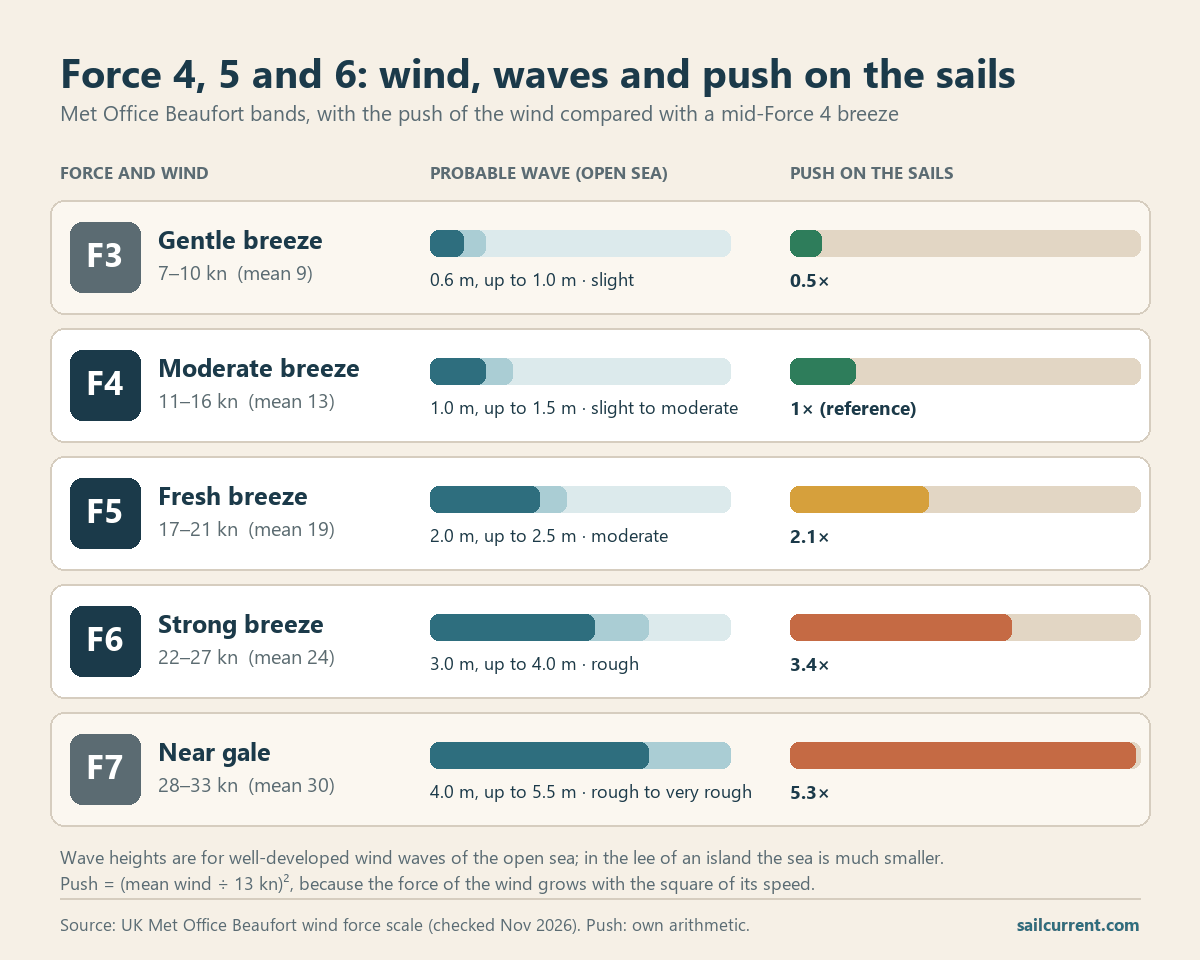
The sea compounds it. The probable wave goes from about 1 metre at Force 4 to 2 metres at Force 5 and 3 at Force 6. A metre of sea lifts a 45-foot yacht gently. Three metres on the nose means the bow climbs a wave, drops off the back and lands with a thump you feel through your feet. Nothing has broken. It is simply hard work, and it is wet.
What does Force 4 feel like on board?
Like proper sailing. At 11–16 knots a 40–46-foot charter monohull carries all her sail, leans at a comfortable angle upwind and moves at a good pace. A catamaran stays almost flat and simply goes. Water chuckles along the hull, the rigging hums, and you talk at normal volume in the cockpit. Upwind, the odd splash comes over the bow; downwind, nobody gets wet at all.
Below decks it is harbour life on a slope. You can make coffee and sandwiches, though anything left on the table upwind ends up on the low side. Sleeping is easy, and in a sheltered anchorage at night nobody would know the breeze was there. This is the wind I would wish on anyone's first week. How the rest of that week runs, from cabins to meals, is in what it is like having a skipper on board.
What changes at Force 5?
The boat gets lively, the first reef goes in, and the galley shrinks to one-pot cooking. At 17–21 knots a monohull carrying full sail leans further than is comfortable and starts turning up into the wind in the gusts. That is the boat saying she has too much sail. Reduce it and she stands up straighter and loses very little speed.
Upwind, this is spray-in-the-cockpit sailing: waterproofs on, and whoever sits on the windward side gets wet. The rigging sings, the halyards tap, and conversations move closer together. Downwind, Force 5 is often the best sail of the week, the boat lifting and running with the waves.
Below, cooking is a matter of one pot, wedged in, done before you leave or after you arrive. If anyone aboard is prone to seasickness, a Force 5 beat with someone reading in the saloon is how you find out.
What does Force 6 feel like, and is it dangerous?
Not dangerous for a well-found charter yacht with a competent skipper, but uncomfortable, especially upwind. The Met Office calls the sea at Force 6 rough, with a probable wave of 3 metres and occasional ones of 4. A modern charter yacht, reefed down, handles that without drama.
What changes is everything human. Upwind, the boat slams, spray crosses the whole cockpit and every move needs a handhold. The wind in the rig is loud enough that you raise your voice. Below, nothing stays where you put it, lunch means sandwiches made in harbour, and a night in an exposed anchorage means a rolling, snatching boat and very little sleep. Downwind, the same Force 6 can be exhilarating for an hour, if the crew is keen and the hop is short.
With children aboard I plan Force 6 as a day in harbour; the reasons are in my guide to the best time to sail the Greek islands. With a keen adult crew, a short downwind leg is fair game. A long upwind leg is not worth the misery.
When does a skipper reef on a typical charter yacht?
Earlier than the boat needs, and before the gust rather than during it. There is no single number. Each boat's manual has its own reefing table, and a monohull with a furling mainsail behaves differently from a catamaran with a big square-topped main. Where the manual gives figures, the manual wins.
My own rule of thumb, offered as a judgement and not a statistic: on a 40–46-foot monohull, the first reef goes in when the steady wind reaches the top of Force 4 and the forecast says it will build, and the second when Force 6 is steady rather than gusting. On a catamaran I reef by the wind instrument, not by feel. A cat does not lean to warn you that she is overpressed; she simply goes faster while the load on the rig keeps climbing.
And the old saying still holds: the time to reef is the first time you wonder whether you should. Shaking a reef out costs five minutes. Putting one in late, in a gust, on a pitching deck, costs much more than that.
Why do fetch and shelter matter more than the forecast number?
Because the Beaufort wave heights describe a sea that has had room and time to grow, and much of a charter week is sailed where it hasn't. The Met Office says so in its notes to the scale: the wave heights refer to well-developed wind waves of the open sea, and the sea lags behind a rising wind. Waves grow with the distance the wind travels over open water, called the fetch, and with how long it has been blowing.
In practice, a Force 6 blowing off an island two miles away builds only a short chop in its lee: noisy and gusty, but flat enough to sail in comfort. The same Force 6 after a long run of open sea is the 3-metre sea in the table. And a breeze that only got up after lunch has not yet built the sea it will have by evening.
That is why a skipper looks at the chart before the number. A Force 5 across an open channel can be a harder day than a Force 6 along a sheltered coast. In the Saronic Gulf the islands sit close together and break up the sea; in the open middle of the Cyclades in a summer northerly, there is far less to hide behind. The Greek sailing weeks I offer cover both, and the planning is different for each.
How do you read a gust forecast?
Plan the sail for the gusts and the route for the mean. A good forecast gives two numbers: the mean wind ("Force 4 to 5") and the gusts ("gusting 25 knots"). The Met Office describes gusts as brief increases in wind speed that can be considerably stronger than the sustained wind between them.
Three things I look at:
The gap between mean and gust. A Force 4 with gusts to 18 knots is a steady day. A Force 4 gusting 28 is a day of sudden heeling and rounding up, and the sail area is set for the 28.
Where the gusts will come from. Wind spilling over high ground and down an island's valleys can arrive in bursts much stronger than the breeze a mile offshore.
The time of day. A summer wind that builds through the day is the reason to leave early, which is the first of the routing moves in the best-time guide.
On Greek waters, meteo.gr's sailing maps give the wind in Beaufort for each point in three-hour steps, with a separate wave map. Their wave height is the average of the highest third of the waves, so expect some bigger ones than the number on the map.
Does the direction of the wind matter as much as its strength?
Yes. On the same forecast, heading upwind can feel two Beaufort forces stronger than heading downwind. What you feel on deck is the apparent wind: the true wind plus the wind made by the boat's own speed.
Take a forecast of 18 knots, a solid Force 5, and a yacht doing 6 knots. Beating upwind at about 45 degrees to the wind, the crew feels roughly 23 knots across the deck, which is Force 6 by the numbers, with the bow punching into the waves. With the wind on the beam they feel about 19 knots. Running straight downwind they feel 12 knots, a Force 4, and the boat rides with the waves instead of against them.
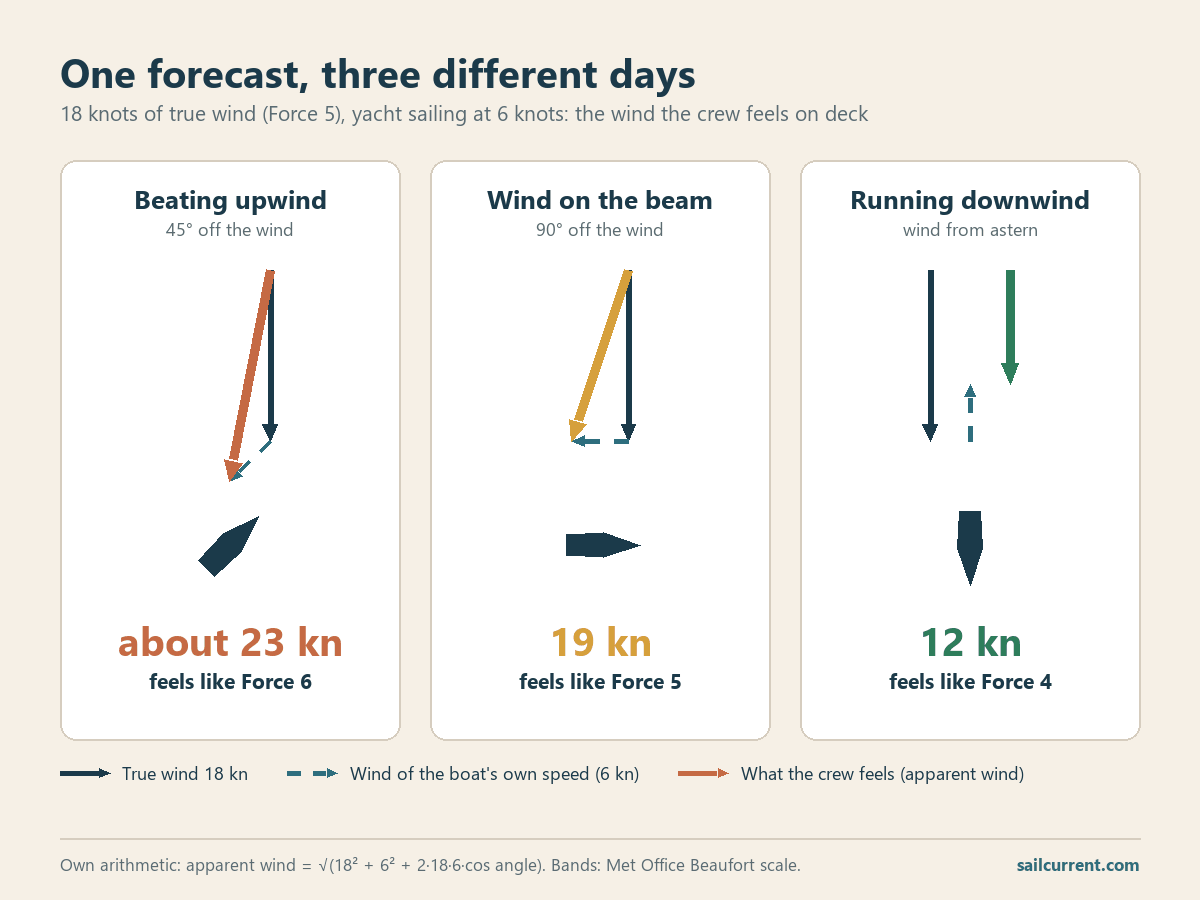
This is the biggest lever a skipper has. The same day can be a slog or a sleigh ride, depending on which island you choose to sail to.
Which force suits which crew?
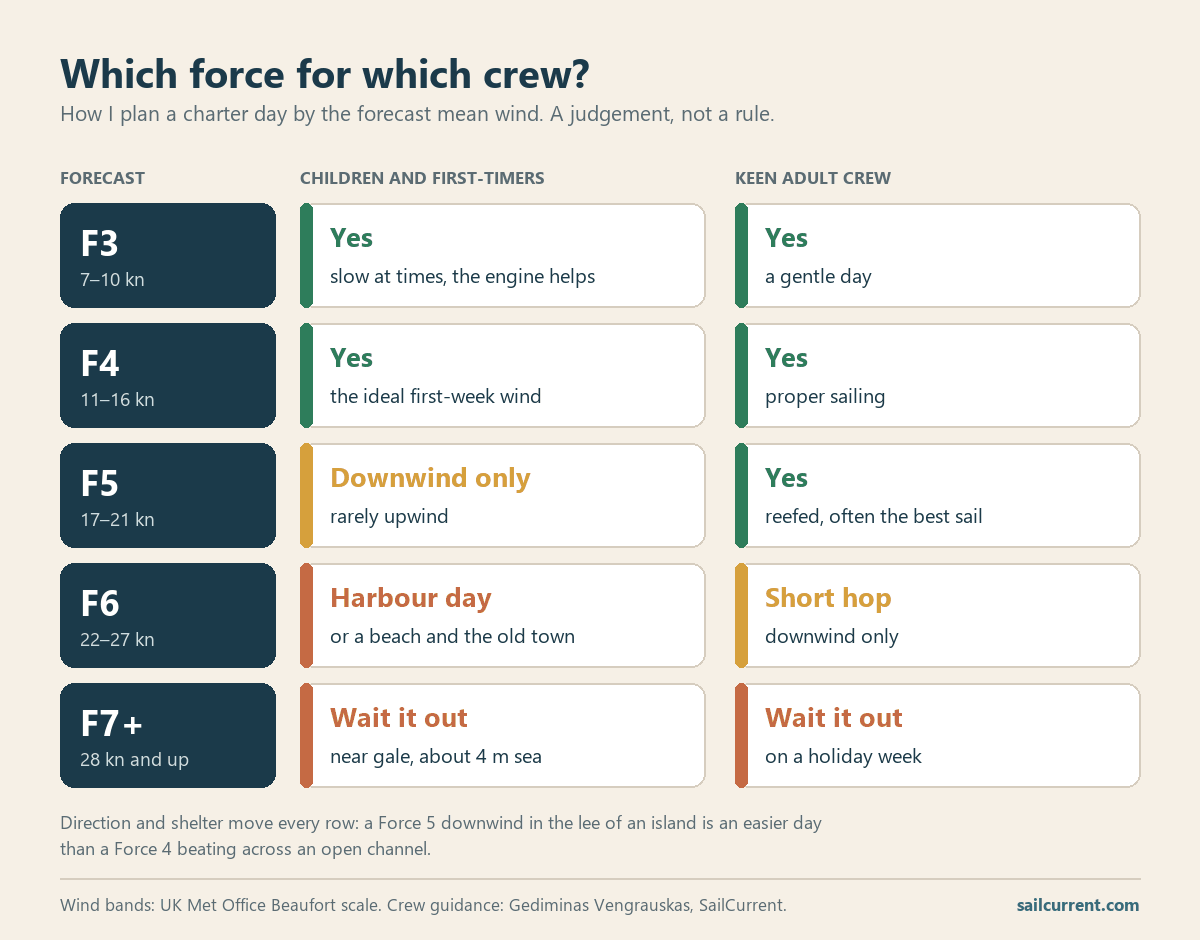
My judgement, not a rule: Force 3 to 4 for first-timers and small children, up to Force 5 for keen adults, and Force 6 only short and downwind.
Force 3: everyone, including people who have never sailed. Sometimes slow, and the engine helps on the longer days.
Force 4: the ideal wind for a first week. The boat sails properly and nobody worries.
Force 5: a great day for a keen crew. For a family it depends on direction: yes downwind, rarely upwind.
Force 6: a short downwind hop for an experienced adult crew; a harbour or beach day with children.
Force 7 and above: a near gale and a probable 4-metre sea in open water. On a holiday week, we wait it out.
A day in harbour is part of the plan, not a failure of it. Old towns and tavernas don't care about the forecast.
What does a skipper actually do on a Force 6 day?
Choose the direction, the shelter and the time, in that order, or stay put. Most of the work happens the evening before, with the forecast and a chart.
Direction: sail to the island the wind favours, even if it was meant for Thursday rather than Tuesday.
Shelter: take the route along the lee of an island rather than across the open channel.
Time: leave early, before a daytime wind builds, and arrive by lunch.
Or stay: if none of those gives a decent day, a second night in the same harbour beats a long slam.
That is a good part of what a skipper is for. Deciding not to sail is easy when the decision belongs to someone with a licence and nothing to prove, and nobody on the crew has to argue for it. If the motion is what worries you most, my comparison of a catamaran and a monohull explains how the two boats behave, and the hire a captain page explains how I work.
FAQ
How many knots are Force 4, 5 and 6?
On the Met Office scale, Force 4 is 11–16 knots, Force 5 is 17–21 knots and Force 6 is 22–27 knots. These are mean wind speeds, averaged over ten minutes; gusts are forecast separately.
Is Force 6 safe on a charter yacht?
For a well-found charter yacht, reefed and with a competent skipper, yes. It is uncomfortable rather than dangerous, especially upwind. With children aboard I treat a Force 6 day as a day in harbour.
What wave height goes with Force 5?
The Met Office gives a probable wave of about 2 metres and a probable maximum of 2.5 metres, for a well-developed open sea. In the lee of an island, or with little open water upwind, the sea is much smaller.
What is the difference between the mean wind and the gusts?
The mean wind is the average over ten minutes. A gust is the strongest three-second average in the period. Gusts can be considerably stronger than the mean, which is why the sail is set for the gusts.
When should you reef a charter yacht?
Earlier than you think, and before the gust arrives. The boat's own manual has its own reefing table and it wins. My rule of thumb on a 40–46-foot monohull is the first reef at the top of Force 4 when the wind is building.
Why does sailing upwind feel so much windier?
Because the boat's own speed adds to the wind you feel. In 18 knots of true wind, a yacht doing 6 knots feels about 23 knots beating upwind and only 12 knots running downwind.
Can you sleep at anchor in a Force 6?
In a well-sheltered bay with land close upwind, usually yes. In an exposed bay the boat rolls and snatches at the anchor all night, so on a Force 6 night I would rather be in a harbour.
Can I hire you as skipper for a 2027 week?
Yes. Every Saturday-to-Saturday week in 2027 is open, except 15–22 May and 2–9 October, which are taken. Tell me your dates and your crew and I will come back to you within 24 hours.
About the author
I am Gediminas Vengrauskas, a Lithuanian skipper with six years of sailing and about 1,000 nautical miles logged. I hold an international Coastal Skipper certificate for sail and motor vessels up to 24 metres, day and night, up to 12 miles offshore, plus an ICC, a VHF radio operator's certificate and a 2026 first-aid certificate. The waters I know best are the Saronic Gulf and Dalmatia, plus the Baltic. I do not own a fleet; your boat comes from a licensed partner charter company, and I skipper it.
Planning a week with a skipper?
Send me your dates, your crew and how much sailing you would like, through the contact form. I reply within 24 hours.
Sources checked November 2026: the UK Met Office's Beaufort wind force scale, its guide to marine forecasts and its notes on how wind and gusts are measured; meteo.gr's sailing maps for Greek seas (National Observatory of Athens); NASA Glenn Research Center's beginner's guide to aerodynamics.
