What's It Like Having a Skipper on Board? Cabins, Meals, Etiquette and Tipping
Written by Gediminas Vengrauskas, licensed Coastal Skipper · ICC · VHF. Updated August 2026.
Key takeaways
The skipper needs a berth of their own, usually the forepeak. Book one more sleeping space than your group needs.
Their food is your cost, not theirs. Provision for one extra adult.
They sail the boat and keep you safe. They do not cook, clean, empty bins or mind your children.
At anchor, the cockpit is effectively yours. Most of the day you will barely notice them.
No major fleet publishes a tipping rate. On a skipper-only booking, 10-15% of the skipper's fee is a fair anchor, roughly €125-230 for a week on my rates.
If you want a quiet boat, say so on day one. Any decent skipper adjusts in five minutes.
The short answer
A skipper costs you one cabin, one extra set of meals and a small slice of privacy, and buys you back the entire holiday. They sleep in the forepeak or a spare cabin, eat what the boat eats because you provision for them, handle the weather, navigation and mooring, and stay out of your evening unless you invite them into it.
The two largest charter fleets in the world put it almost identically. Sunsail's own skippered charter FAQ says all you need to do is give the skipper their own cabin, keep food and drink aboard for them as well as for you, and decide for yourself whether to invite them to meals. The Moorings publishes the same. Everything past that is preference.
Where does the skipper actually sleep?
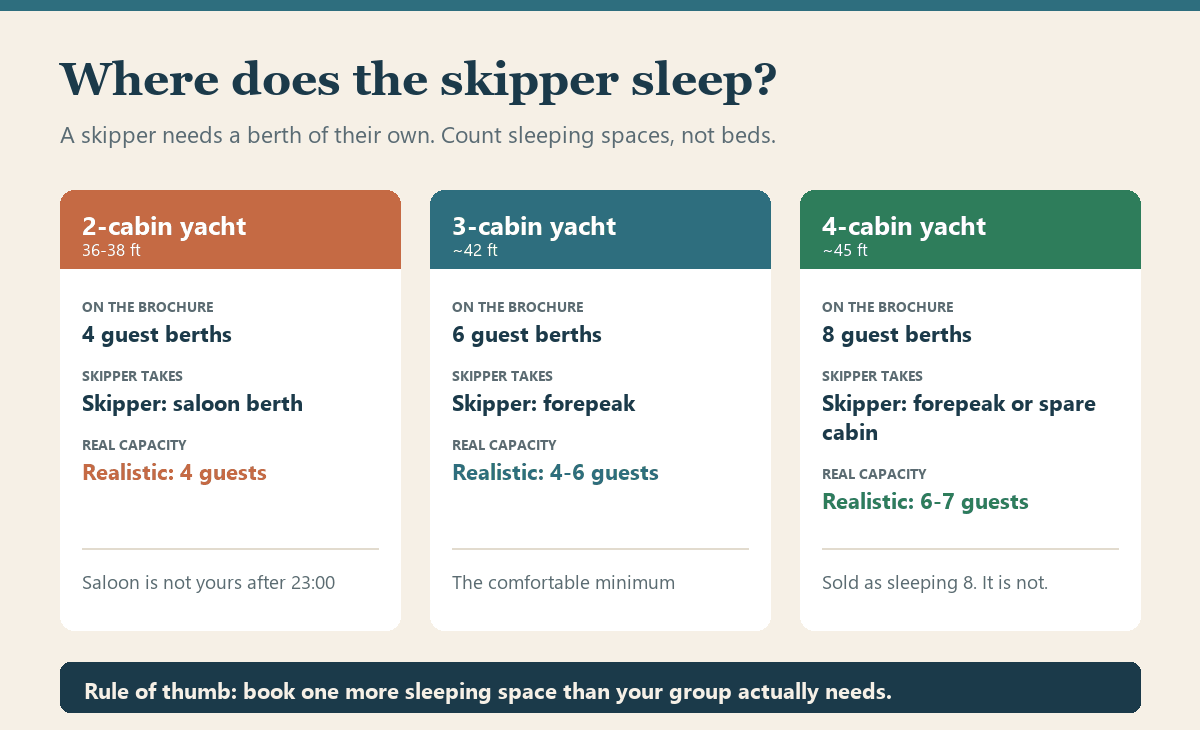
In the smallest berth on the boat, almost always: the forepeak, that wedge-shaped cabin right in the bow, or a spare double if your group has not filled the yacht. Sunsail and The Moorings both state that a forepeak is acceptable for a skipper but has to be flagged when you book, and that if a proper interior cabin is free the skipper takes that instead.
The practical version: count sleeping spaces, not beds. A four-cabin 45-footer is sold as sleeping eight. With a skipper aboard, treat it as a boat for six or seven guests.
On a two-cabin yacht of 36 to 38 feet there is often no third berth at all, so the skipper converts the saloon table each night. It works, but the saloon stops being yours at about 23:00. If your crew likes staying up with a bottle of wine, size up one boat. It is the cheapest comfort you will ever buy.
Do I have to feed the skipper?
Yes, and it is the single most common surprise. Both Sunsail and The Moorings state plainly that you must have food and drink aboard for your skipper as well as your own party. The daily fee pays for their work, not their groceries.
In money that is one extra adult on the provisioning list. Some operators let you pre-pay skipper provisioning at booking, which is worth asking about.
Restaurants are the grey area and there is no rule. Sunsail's own advice is simply to tell the skipper your dining plans, either inviting them along or letting them know provisions are aboard. My view: if the boat is eating ashore most nights, settle it out loud on day one rather than letting it hang over every bill.
Do we eat together?
Entirely your call, and nobody sane is offended either way. Sunsail publishes this almost word for word: invite your skipper to mealtimes, or enjoy the time with your own group.
What usually happens is a mix. Lunch at anchor is shared by geography more than by decision, since there are only so many places to sit on a 45-foot boat. Dinner is where the choice actually gets made, and it can move as the week does. On mess, both fleets state that skippers clear up after themselves in the galley. You are not acquiring a teenager.
What does a skipper actually do all week?
More than it looks like from the cockpit. Drawing on what Sunsail and The Moorings both publish as skipper responsibilities:
Weather and route. Reading the forecast and deciding what it means for your plan, usually before you are awake.
Navigation and pilotage. Charting the course, watching conditions, keeping everyone aboard safe.
Mooring and anchoring. Reversing onto a packed Greek town quay at 18:30 with a crosswind and an audience is a skill, and it is the biggest single reason holidays go wrong on bareboats.
Safety and systems briefings on day one: gas, water, heads, safety kit, where everything lives.
Dinghy runs ashore when the anchorage has no quay.
Deck housekeeping. Lines tidy, gear stowed, water and gas refilled. You pay the fees, the skipper handles the doing.
Local knowledge. Which bay rolls in a northerly, which quay has power that works, which taverna is worth the walk.
For context on what I am licensed to do: an internationally valid Coastal Skipper certificate for sail and motor vessels up to 24 metres and 12 nautical miles offshore, day and night, plus ICC and VHF, carrying up to 12 people.
What is the skipper not there for?
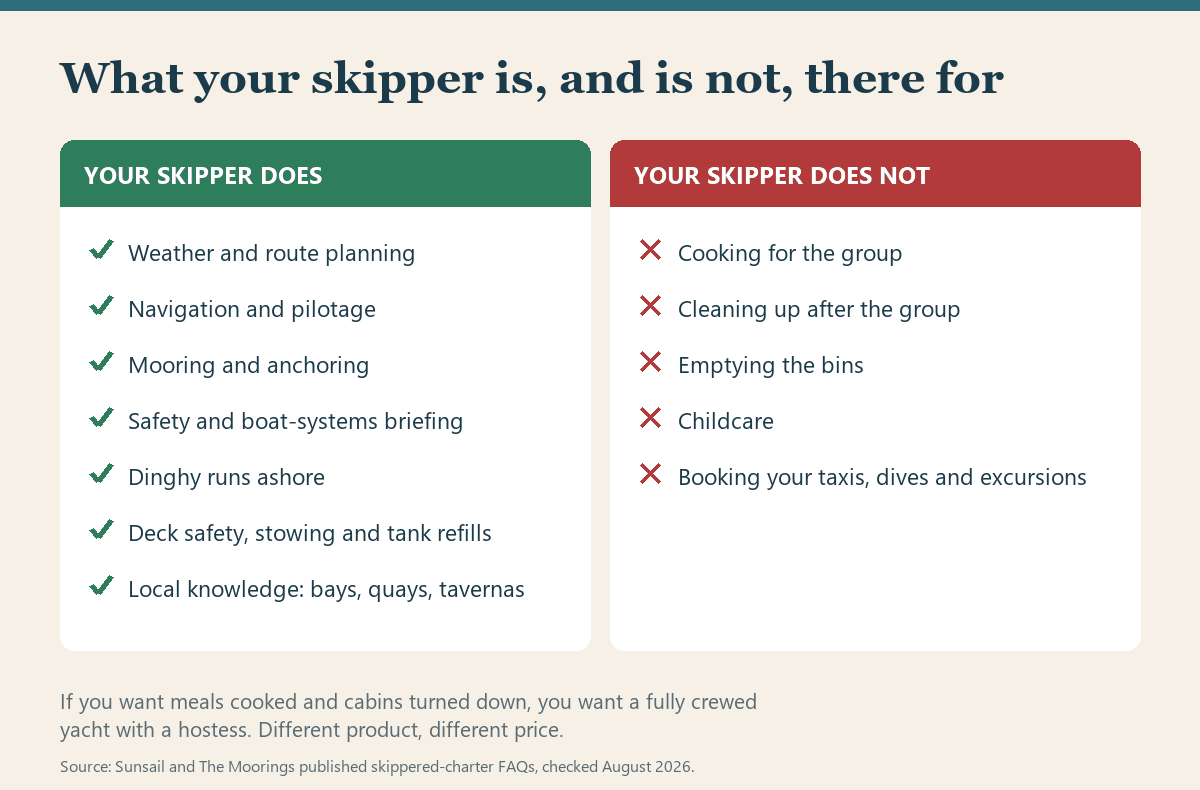
This list is where expectations break, and Sunsail and The Moorings publish an identical version of it. Your skipper is not responsible for:
Cooking for the group
Cleaning for the group, beyond tidying up after themselves
Emptying the bins
Childcare
Booking your taxis, dive trips and shore excursions
If you want meals cooked and cabins turned down, the product you want is a fully crewed yacht with a hostess, and it costs considerably more. A legitimate choice, just a different one. I compared all four options in skippered vs bareboat vs flotilla vs cabin charter.
Will it feel like a stranger is living with us?
For about two hours. Then it stops, and the reason is structural rather than social: the skipper is working while you are on holiday, so the days separate themselves. They are up early with the forecast, busy on passage, and often ashore in the evening while you are still at the table.
What genuinely helps is saying what you want out loud on the first afternoon. Sunsail's own guidance to guests is exactly this: your skipper can be as discreet or as interactive as you need, so tell them on boarding if you would prefer a more private trip. Nobody takes offence. If the week is a honeymoon or a proposal, say so when you book rather than when you board.
How much privacy do you actually keep?
More than people fear. Being specific is more useful than being reassuring:
Your cabin is yours. Nobody opens that door.
At anchor the cockpit is effectively yours. A skipper working since six will be forward in the shade, below, or swimming.
Under way you share the cockpit, because the skipper is at the helm. It is also usually the best part of the day.
Evenings in port are often solo. Skippers know other skippers, and town quays are sociable.
The heads and shower are shared unless the yacht has a separate crew heads. Worth checking on smaller boats.
So the loss is real, but it is smallest exactly when you want privacy most, in the quiet hours at anchor.
Who decides where we go each day?
You do, within the weather. A skipper's veto is about safety and comfort, never preference, and a good one explains the reasoning rather than announcing a decision.
In Greece in July and August the Meltemi decides more of your itinerary than you do, and a skipper's real value is knowing which islands stay pleasant when it blows. The pattern that works is to agree the shape of the week on day one, then confirm tomorrow over dinner tonight, once the forecast has actually updated. For what a realistic week looks like written out, I published a day-by-day Saronic Gulf itinerary.
What are the unwritten rules on board?
None of it is precious. All of it prevents friction.
No street shoes on deck. Bare feet or soft soles.
Nothing goes in the heads that you have not eaten first, plus a modest amount of paper. A blocked marine toilet in August is week-defining.
Water is finite. Short showers, tap off while you soap.
Off-watch time is real. A shut forepeak door at three in the afternoon means someone was reading GRIB files at six in the morning.
Nothing loose on the coachroof. Phones, sunglasses and winch handles all sink at the same speed.
The skipper does not drink while responsible for the boat. Do not read anything into it, and do not push.
If something bothers you, say it on day two, not in a review three weeks later.
How much should you tip a skipper?
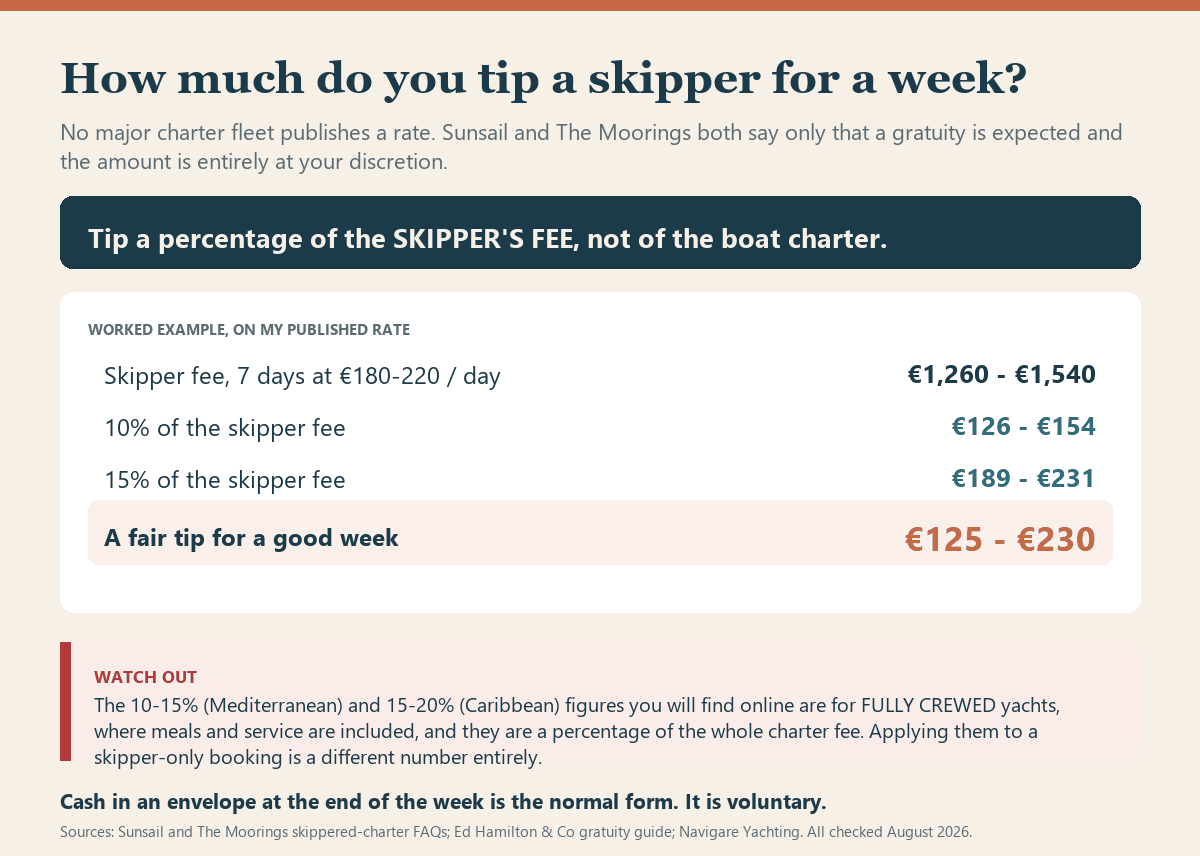
Nobody publishes a rate for a skipper-only booking, and most percentages you will find online are for a different product entirely. That is the honest starting point, and it is why the question causes so much anxiety.
What the industry actually says, checked this month:
Sunsail and The Moorings both state, in identical words, that a gratuity is expected, given at the end of the charter, and that the amount is entirely at your discretion. Neither publishes a percentage.
Ed Hamilton & Co, a long-established broker, publishes 10-15% of the charter fee in the Mediterranean and 15-20% in the Caribbean. Read the caveat: that page is explicitly about fully crewed yachts with meals and service included, and it says that if the fee excludes meals, base the tip on the boat fee alone.
Navigare Yachting, which runs bases in Athens and Trogir among others, publishes 15-25% of the crew fee, handed to the skipper directly at the end.
The useful principle hiding in there: a skipper tip is a percentage of the skipper's fee, not of the boat. Tipping 15% of a €4,000 yacht charter to one self-employed sailor makes no sense to anyone involved.
Worked out on my published rate of €180-220 per day, a seven-day week is €1,260-1,540 of skipper fee. Ten per cent is €126-154, fifteen per cent is €189-231. Call it €125-230 for a good week. That is a typical range I am reporting, not a price anyone charges. Cash in an envelope at the end is the normal form. And if the week genuinely was not good, do not tip, but do say why.
What does a skipper cost, and what is not included?
My skipper service is €180-220 per day for a week aboard, and €220-250 for a private day sail out of Athens. On top of that sit the two things this article is about: the skipper's food, and one berth of your boat. Separate lines on any honest quote:
The yacht. €2,500-4,500 per week in Greece, €2,300-4,500 in Croatia, from licensed partner fleets. I do not own a fleet, and I would rather say so.
Fuel, water and harbour fees. €200-400 per week in Greece, €300-500 in Croatia.
End cleaning. €150-250.
For the whole thing added up line by line, see my full cost breakdown for a skippered week in Greece, or the Greece charters page, which has a calculator attached.If you are hiring a skipper on their own, for your own boat or a charter you have already booked, hiring a freelance skipper sets out the published day rates, expenses, insurance and licence checks.
Is a skipper worth it on a first charter?
For most first-timers, yes. With a skipper aboard nobody in your group needs a sailing qualification, which removes the entire licence problem in one step, as I set out in do you need a licence to charter a boat in Greece. And the hard parts of a sailing week are not the sailing: they are the mooring, the anchoring, and the decision to leave two hours earlier than planned. Those are the parts that turn a holiday into an argument, and exactly the parts a skipper absorbs.
When is it not worth it? If you are already qualified and what you want is solitude and the satisfaction of doing it yourself, hire the boat and go.
FAQ
Does the skipper need their own cabin?
Yes, in almost all cases. Sunsail and The Moorings both require you to provide the skipper with their own cabin, usually the forepeak or a spare interior cabin. On small two-cabin yachts the skipper may sleep in the saloon instead, which works but costs your crew that space at night.
Do I have to buy the skipper's food?
Yes. Both major fleets state that you must have food and drink provisions on board for your skipper as well as your own party. The daily fee covers the skipper's work, not their groceries. Budget one extra adult for the week.
Do we have to eat meals with the skipper?
No. Inviting your skipper to meals is entirely optional and no skipper will be offended if you keep dinners to your own group. Most weeks end up mixed, with lunch at anchor shared simply because everyone is in the same cockpit.
Will the skipper cook or clean for us?
No. Cooking, cleaning for the group, emptying bins, childcare and booking excursions all sit outside a skipper's job, as both Sunsail and The Moorings state. A skipper tidies up after themselves. If you want meals and service, you need a fully crewed yacht with a hostess.
How much do you tip a skipper for a week?
No major fleet publishes a figure, only that a gratuity is expected and the amount is at your discretion. A sensible anchor is 10-15% of the skipper's fee rather than of the boat charter. On a rate of €180-220 per day, a seven-day week works out at roughly €125-230, usually cash at the end.
Can we still have privacy with a skipper on board?
Yes, more than most people expect. Your cabin is private, and at anchor the cockpit is effectively yours because the skipper will usually be forward, below or ashore. Tell your skipper on the first day if you want a quieter week.
Do I need a sailing licence if I hire a skipper?
No. With a licensed skipper aboard, no member of your group needs any sailing qualification. The licence requirement applies to bareboat charter, where the charterer must hold a recognised offshore certificate and sail with a second experienced crew member.
How many people can sail with a skipper on board?
Up to 12 people on the yachts I skipper, which is the recreational limit under my licence. Count the skipper's berth separately, so a boat advertised as sleeping eight is really a boat for six or seven guests plus a skipper.
About the author
I am Gediminas Vengrauskas, a Lithuanian licensed captain with six years of sailing behind me. I hold an internationally valid Coastal Skipper certificate for sail and motor vessels up to 24 metres and up to 12 nautical miles offshore, by day and by night, plus an ICC and a VHF radio certificate. I run skippered sailing holidays in Greece, from the Saronic Gulf and the Cyclades to the Ionian out of Lefkada, and in Croatian Dalmatia from Split and Trogir, and I take captain-for-hire work worldwide. The boats come from licensed partner fleets. I do not own a fleet, and everything I publish about prices is what I actually charge.
If you are weighing up a skippered week and want a straight answer rather than a brochure, tell me what you have in mind or message me on WhatsApp. It is just me answering, and I reply within 24 hours. You can also read about hiring me as a captain or about skippered charters in Croatia.