Updated 21 July 2026 · Written by Gediminas Vengrauskas, licensed Coastal Skipper (ICC · VHF)
Key takeaways
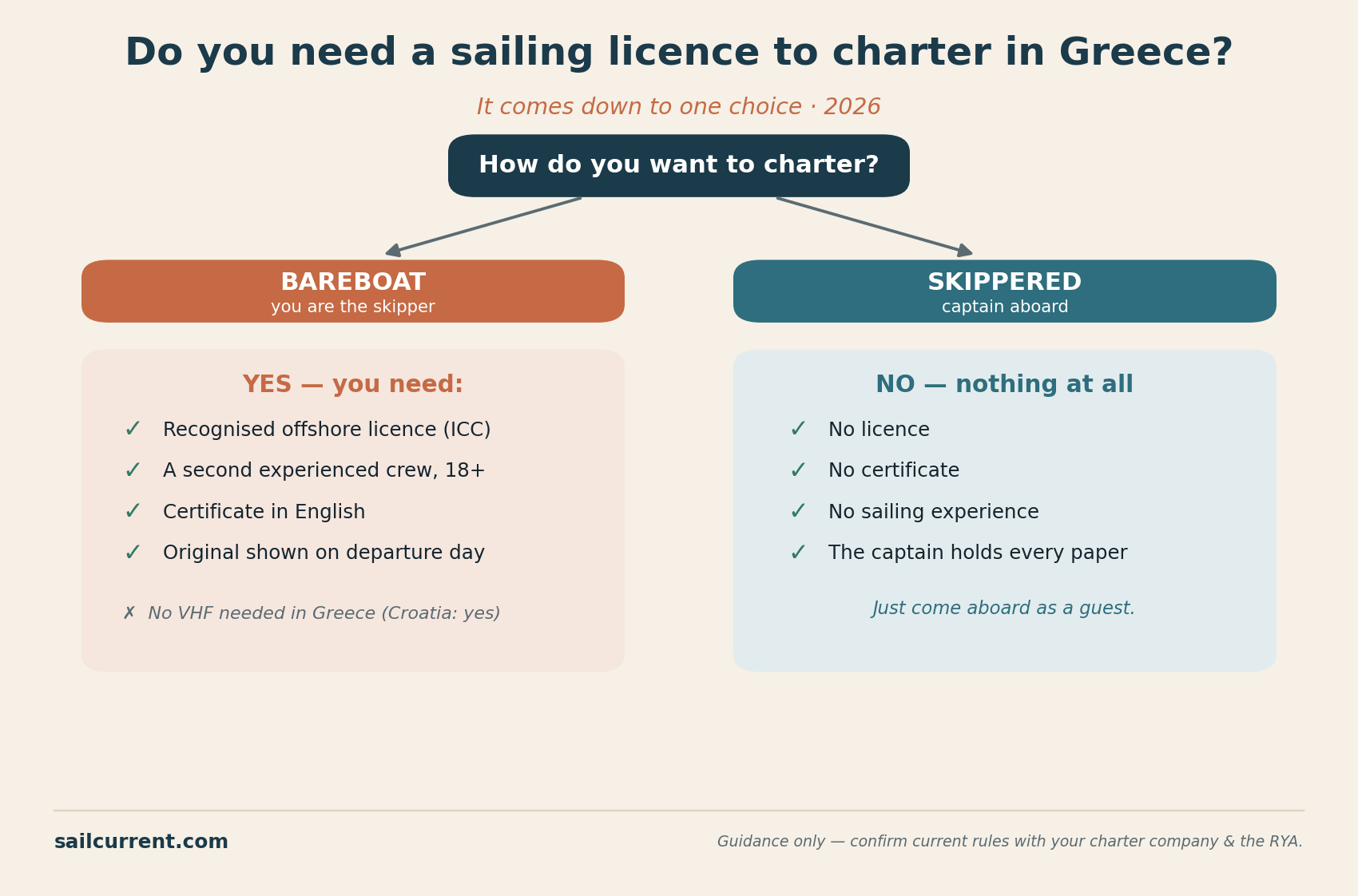
To charter bareboat (no professional aboard) in Greece, the person in charge needs a recognised offshore sailing licence — the ICC is the safest bet — plus a second experienced crew member over 18.
Greece stopped accepting the RYA Day Skipper in March 2019 because it is daylight-only. Any certificate limited to daylight, or to within 12 nautical miles of shore, can be turned away.
Greece does not require a VHF radio licence. Croatia does — a separate certificate on top of the sailing licence.
Charter with a skipper and you need nothing at all: no licence, no certificate, no experience. The captain's papers cover the boat.
Your certificate must be in English, sent to the charter base at least two weeks ahead, and shown as an original to the port authority on the morning you leave.
The short answer: it depends on how you charter. To take a yacht out bareboat, yes — Greek port authorities require the skipper to hold a recognised offshore sailing licence (the ICC is the safe choice), plus a second experienced crew member. But if you charter with a skipper — me, or any licensed captain — you need nothing at all. No licence, no logbook, no experience. You come aboard as a guest, and the certificates, the port police and the night navigation are my problem, not yours. That one choice is the whole difference between revising for an exam and simply booking a holiday.
I am a licensed captain who runs skippered weeks in Greece and Croatia, so I deal with these rules for a living. Below is the honest, complete picture — what is accepted, what is quietly refused on the dock, how to get a licence if you want one, and why most people decide they would rather not bother.
What licence do you need to charter a bareboat in Greece?
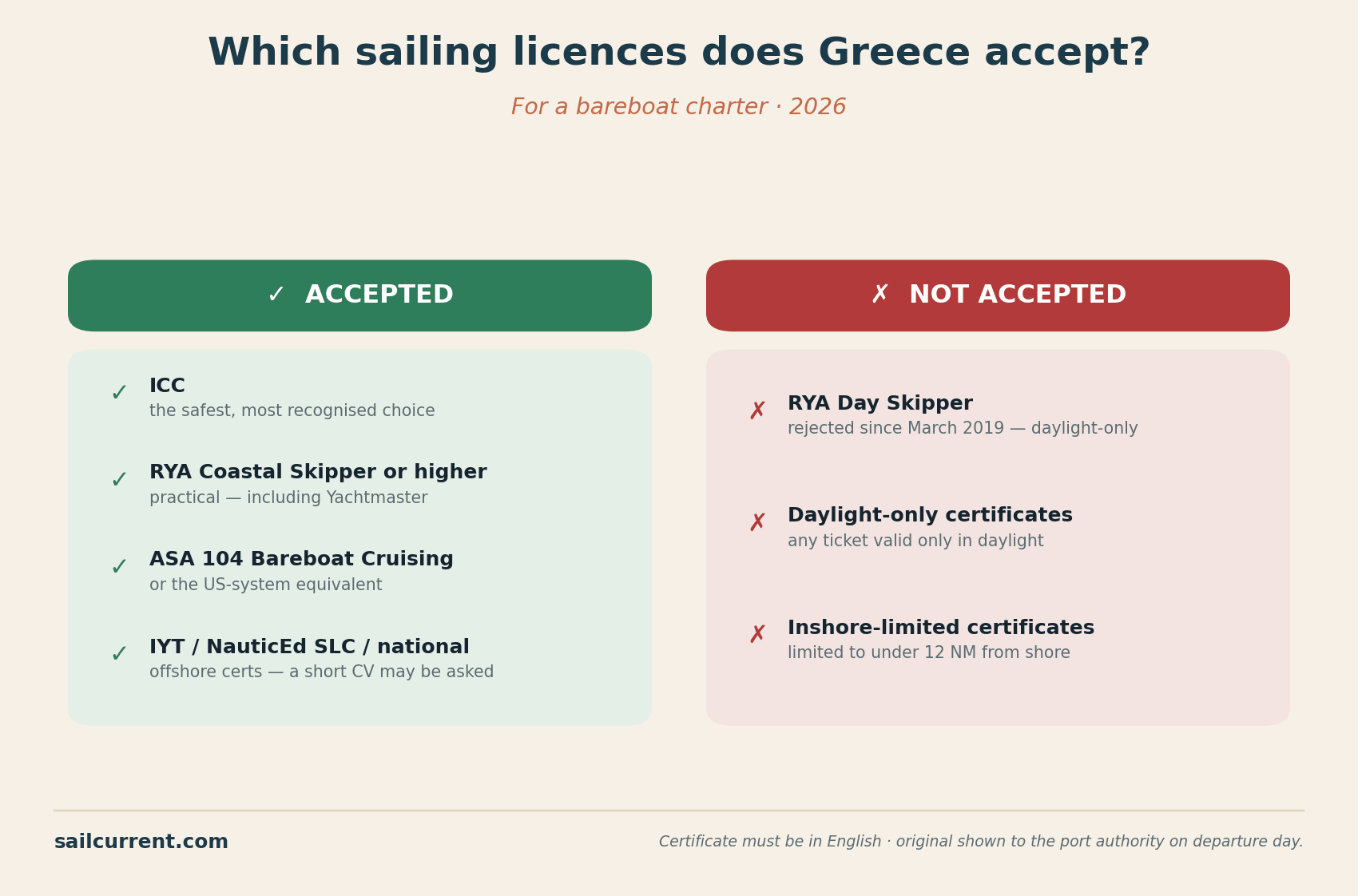
For a bareboat charter — where you are the captain of record — Greek port authorities want to see an internationally recognised sailing certificate that is valid for offshore, open-water sailing by day and night, and written in English. The certificate is checked by the local port authority (the limenarchio) on the morning you leave, and you, as the charterer, are responsible for it being suitable.
The catch is that not every "sailing licence" qualifies. Certificates limited to daylight only, or to within 12 nautical miles of shore, can be refused at the desk. The most important example: since March 2019, Greece no longer accepts the RYA Day Skipper, precisely because it is a daytime qualification. That single change has caught out a lot of people who booked in good faith.
Accepted for bareboat in Greece:
ICC (International Certificate of Competence) — the safest, most widely recognised choice
RYA Coastal Skipper (practical) or higher, including Yachtmaster
ASA 104 Bareboat Cruising or equivalent (US system)
IYT, NauticEd SLC or national offshore certificates — usually accepted, though a short sailing CV may be asked for
Not accepted, or refused on the dock:
RYA Day Skipper — rejected since March 2019 (daylight-only)
Any certificate limited to daylight sailing or to under 12 nautical miles
When in doubt, arrive with an ICC. It is the qualification the port authorities recognise without hesitation.
Is the ICC accepted in Greece?
Yes, in practice. The International Certificate of Competence (ICC) is the most widely recognised pleasure-craft qualification in the Mediterranean. It is issued on the basis of a United Nations agreement (UNECE Resolution 40). Technically Greece has never formally ratified that resolution — but Greek port authorities accept the ICC anyway, which makes it the single most reliable document to arrive with.
How do I get an ICC, and what does it cost?
Straightforward, and worth knowing even if you lean towards a skippered week:
Cost: free if you already hold a suitable RYA certificate and are an RYA member; otherwise roughly £216 for the assessment, or €200–€500 for a short course that includes preparation and the exam.
Time: often a single day if you already have real experience; some schools ask for two or three days.
Validity: an ICC is valid for five years and renews by declaration — no re-test.
You can apply through the RYA, which administers the ICC in the UK. If that already sounds like more admin than holiday, that is exactly what a skipper is for.
Do you need a second qualified crew member?
For bareboat, effectively yes. Greece sets a minimum of one valid offshore licence plus one experienced "co-skipper" — two capable people aboard, not one. That second person does not always need a formal certificate, but they must be over 18 and genuinely able to help if something goes wrong, and you as the charterer answer for whoever you name. In many cases the port authority asks the co-skipper to sign a declaration of competence, and occasionally to show a short sailing CV.
None of this is meant to put you off bareboating — plenty of qualified crews do it happily every season. It is meant to show why so many people quietly decide it is not the holiday they had in mind.
Do you need a VHF radio licence in Greece?
No. Greece does not require a separate VHF radio operator's certificate for a pleasure charter. Worth knowing if you are comparing destinations, because Croatia does — a marine radio certificate on top of the skipper's sailing licence.
What if nobody in your group has a licence?
Then you charter with a skipper, and the whole question disappears. On a skippered charter, your guests need no licence, no certificate and no prior sailing experience whatsoever. The professional aboard holds the qualifications, signs for the boat, handles the port formalities, and plans around the weather. Everyone else is simply a guest enjoying the trip.
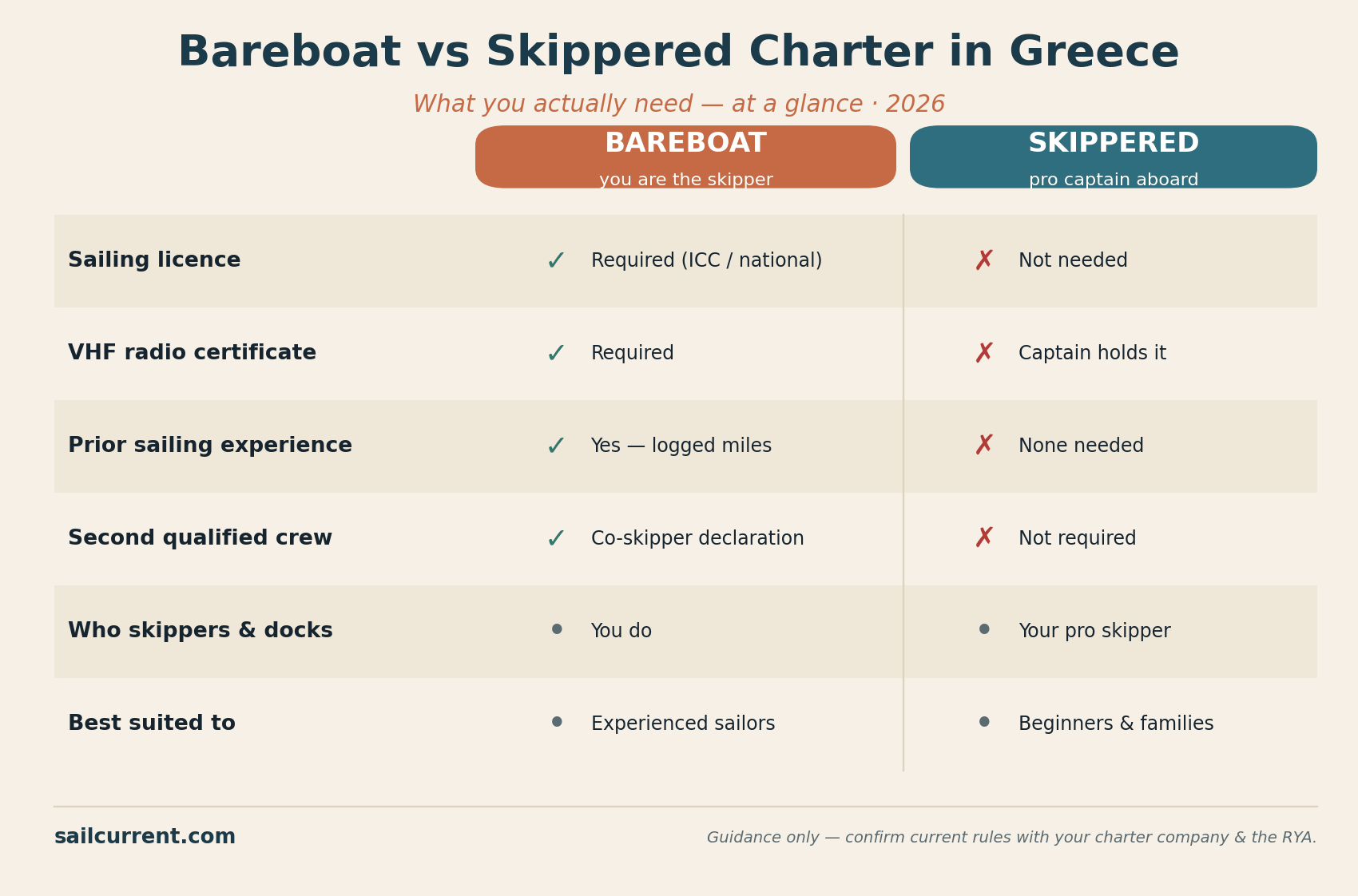
That really is the point of a skippered week — no licence, no experience, no problem. You get a private yacht or catamaran; I do the sailing and the paperwork; you do the swimming and the sunsets. Here is the difference, side by side:
Bareboat charter — what you need: a recognised offshore licence (ICC); a second experienced co-skipper (18+); a VHF certificate in Croatia (not Greece); real sailing experience, checked on the dock; and you plan the route and weather yourself. Best for qualified crews who love the planning.
Skippered charter — what you need: nothing. No licence, no second crew, no VHF, no experience. The skipper plans the route and weather with you. Best for first-timers, families, and anyone who wants to switch off completely.
What qualifications does your skipper hold?
A fair thing to ask any captain before you hand over a holiday. I am a licensed Coastal Skipper, valid for sail and motor vessels up to 24 metres, for day and night passages up to 12 nautical miles offshore. I also hold the ICC and a VHF radio operator's certificate — the exact papers the port authorities want to see, in both Greece and Croatia. When you book a skippered charter with me, my licences cover the boat, so yours never come into it.
How is Croatia different from Greece?If you are still weighing up the options, I compare all four ways to charter — bareboat, skippered, flotilla and cabin charter — in this honest side-by-side guide.
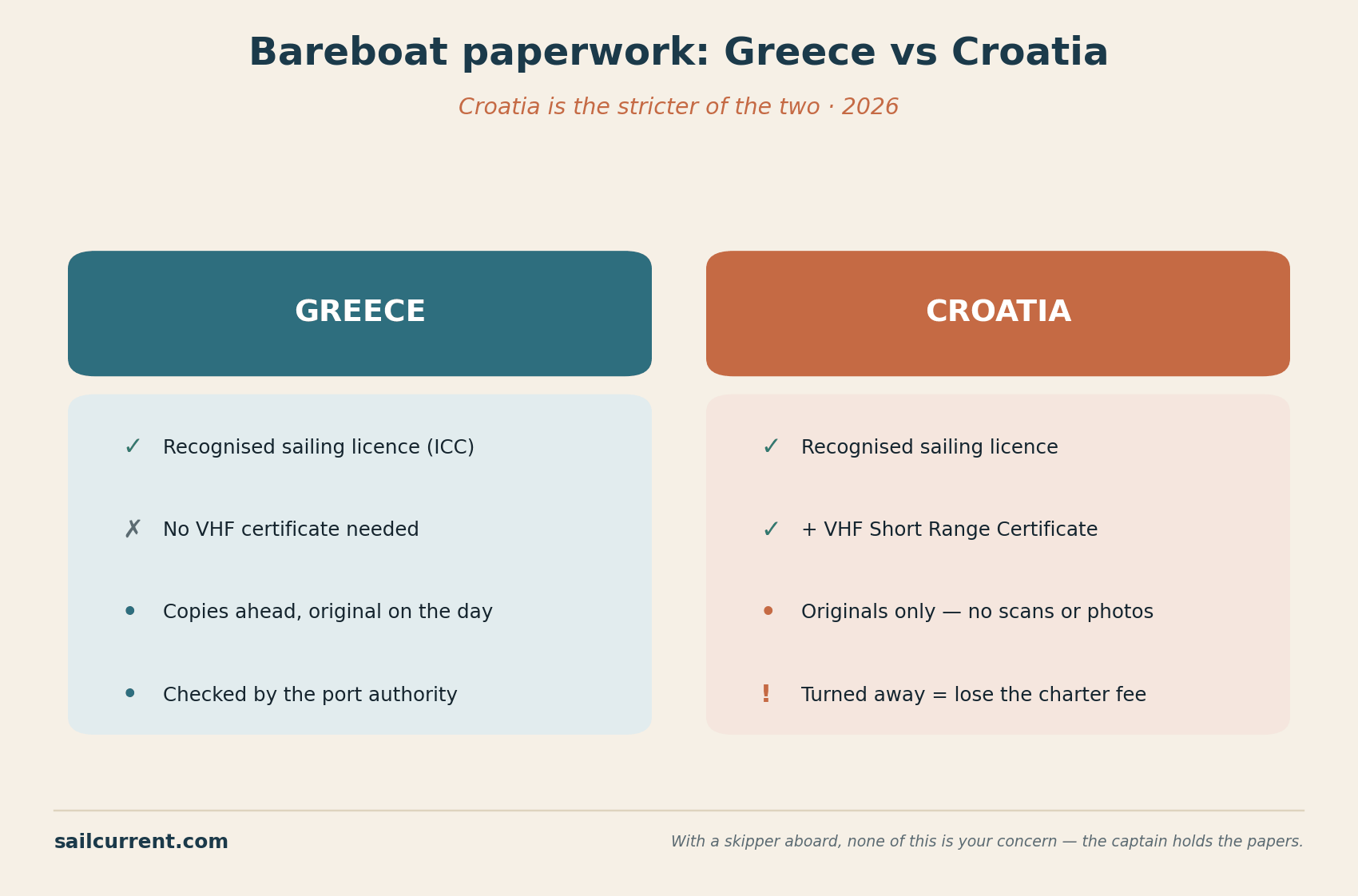
If you are choosing between the two, the paperwork is genuinely different — and Croatia is the stricter of the two:
VHF certificate required. A Croatian bareboat skipper needs both a recognised sailing licence and a VHF Short Range Certificate. Greece does not ask for the radio ticket; Croatia insists on it.
Originals only. Croatian harbour masters want the physical, original certificates at handover. A scan or a phone photo is refused. Greece is a little more relaxed, but always travel with originals.
Strictly enforced. Croatia turns non-compliant skippers away at the dock — and you can lose the charter fee.
The requirements shift from border to border, but one thing travels everywhere: the captain holds the papers.
What paperwork and port checks happen before you sail?
If you do go bareboat, here is the real sequence, so nothing surprises you:
Two to four weeks before: email scanned copies of every skipper and co-skipper certificate to the charter base to be pre-checked.
At check-in: hand over the original certificates, ID for the crew list, and a refundable security deposit.
On departure morning: the local port authority may inspect the skipper's licence before you are cleared to leave — this is where an unsuitable certificate gets caught.
Throughout the week: keep the boat's papers aboard and follow local harbour rules.
On a skippered charter I handle all of the boat-side formalities with the fleet myself. You just tell me who is coming.
So which should you choose — bareboat or skippered?
If you and a friend both hold offshore tickets, love the planning and want the boat entirely to yourselves, bareboat is a fine thing, and I will gladly point you to a reputable fleet. If the licensing paragraphs above made your eyes glaze over, hire a skipper and spend the week on holiday instead of on formalities. There is no wrong answer here — only an honest one about how you want to spend your time. My own view, after years of doing this: for a first charter, a first family trip, or any group that wants to switch off completely, a skipper is worth every euro.
FAQ
Do I need a licence to sail in Greece if I hire a skipper?
No. With a licensed skipper aboard, nobody in your group needs a licence, a certificate or any experience. The skipper's qualifications cover the boat.
Is an ICC enough to charter bareboat in Greece?
Yes. The ICC is accepted by Greek port authorities and is the most reliable certificate to arrive with. Day-only or inshore-limited licences can be refused.
Does Greece accept the RYA Day Skipper?
No. Since March 2019 Greek authorities no longer accept the RYA Day Skipper for bareboat charter, because it is limited to daylight sailing. Upgrade to an ICC or RYA Coastal Skipper.
Do I need a VHF radio licence to charter in Greece?
Not in Greece. Croatia does require a VHF Short Range Certificate. On a skippered charter it makes no difference — the skipper holds the radio licence.
Does the second crew member need a licence too?
For bareboat you need one licensed skipper plus one experienced person over 18. That second person may not need a formal certificate, but the port authority can ask them to declare their competence in writing.
Can a complete beginner charter a yacht in Greece?
Yes — with a skipper. Skippered charters are designed for non-sailors, first-timers and families; you need no qualifications at all. To go bareboat, you would need a recognised offshore licence yourself.
How much does an ICC cost and how long is it valid?
Roughly £216 for the assessment (free if you already hold a suitable RYA certificate as a member), or €200–€500 for a short course that includes the exam. An ICC is valid for five years and renews by declaration.
Can I charter a catamaran without a licence in Greece?
The licensing rules are the same for a catamaran as for a monohull. Bareboat needs a recognised offshore licence; with a skipper, you need none.
About the author
Gediminas Vengrauskas is a Lithuanian licensed Coastal Skipper (sail and motor vessels up to 24 m, day and night passages, ICC and VHF certified) and the captain behind SailCurrent. He runs skippered sailing holidays in Greece and Croatia, day sails from Athens, and captain-for-hire worldwide — a genuine one-person operation, so you always talk directly to the captain who will sail with you. Questions get an honest answer within 24 hours.
Ready to skip the paperwork?
Tell me your dates and your crew and I will say honestly whether bareboat or a skippered week suits you better — and what it will cost, all in (I have broken the real numbers down in a separate post on skippered-charter costs). You can see how a skippered week works on my Greece charters page, read exactly what a captain does on the hire a captain page, or just send me your dates. I reply within 24 hours.