The Best Time to Sail the Greek Islands: A Month-by-Month Wind Guide
Written by Gediminas Vengrauskas, licensed Coastal Skipper · ICC · VHF — Updated September 2026
The short answer
June is the best month to sail the Greek islands for most crews — but which island group you choose matters about twice as much as which month. Across the whole April-to-October season, the largest month-to-month swing in mean wind at any Greek station is 4.9 knots. The gap between the calmest and the windiest island group in a single August is 10.2 knots. Pick the water first. Then pick the month.
Key takeaways
Corfu averages 3.6 knots of wind in July. Naxos averages 13.3. Same country, same week, almost four times the wind.
Naxos in its calmest month is still windier than Athens, Corfu, Kefalonia, Chania or Kalamata in their windiest.
June is the quiet month nobody recommends: in the Cyclades it runs three knots below July while the air is already 23.5°C.
The Meltemi does not fade in autumn. October is the windiest month of the sailing season at Naxos, Skyros and Kythira.
A monthly average is not a day you will sail. Force 5 gusts reach Force 6 — and stepping from Force 4 to Force 6 triples the wave height while only doubling the wind.
The Ionian buys you flat water and pays for it in rain. In September Corfu takes 87.8 mm across 7.4 wet days; Naxos takes 7.7 mm across 1.9.
What is the Meltemi, and why does everyone warn you about it?
The Meltemi is the dry northerly that blows down the Aegean through the summer. Greece's national met service uses its older name, the Etesian, and describes it in a sentence most holiday guides leave out: during the warm season, high temperatures are "dampened from the fresh sea breezes in the coastal areas of the country and from the north winds blowing mainly in Aegean, well known as 'Etesian'".
That is the half of the story the warnings skip. The Meltemi is not something that happens to a Greek summer — it is the reason the Cyclades are liveable in August. Naxos averages 25.1°C in July against the Athens coast's 28.3. Those three degrees are the wind's doing.
It earns its reputation too. It does not arrive as a steady background breeze. It comes in blocks of two to four days, it accelerates through the gaps between islands, and it can keep a boat in harbour for a day. But it is one wind, in one corridor, of one sea — and most people planning a Greek sailing holiday never go near it.
How windy is each Greek island group, month by month?
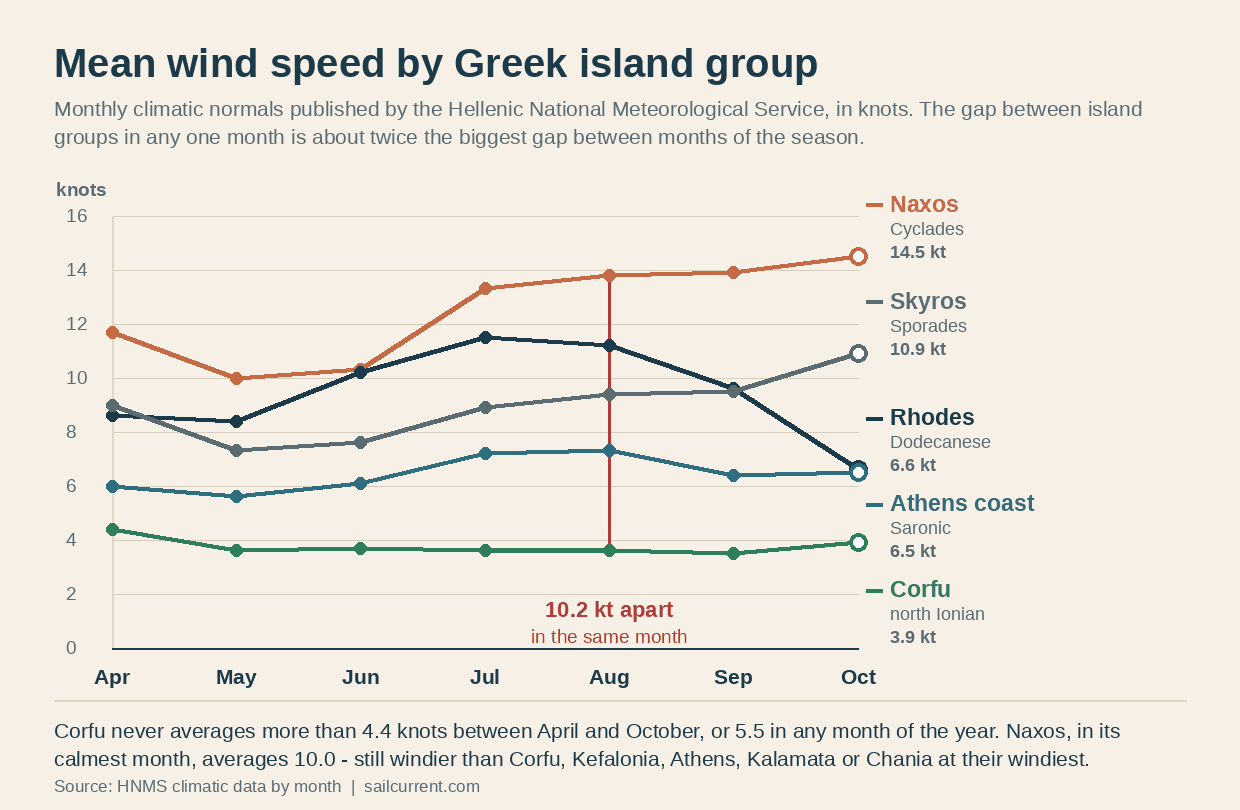
Very differently, and the differences between places are far larger than the differences between months. These are the published climatic normals for mean wind speed in knots, April to October.
Corfu, north Ionian — Apr 4.4, May 3.6, Jun 3.7, Jul 3.6, Aug 3.6, Sep 3.5, Oct 3.9
Kefalonia, south Ionian — Apr 6.4, May 6.0, Jun 6.2, Jul 6.6, Aug 6.1, Sep 5.7, Oct 6.0
Athens coast, Saronic — Apr 6.0, May 5.6, Jun 6.1, Jul 7.2, Aug 7.3, Sep 6.4, Oct 6.5
Chania, west Crete — Apr 7.8, May 7.0, Jun 7.3, Jul 6.9, Aug 6.4, Sep 6.0, Oct 6.1
Skyros, Sporades — Apr 9.0, May 7.3, Jun 7.6, Jul 8.9, Aug 9.4, Sep 9.5, Oct 10.9
Rhodes, Dodecanese — Apr 8.6, May 8.4, Jun 10.2, Jul 11.5, Aug 11.2, Sep 9.6, Oct 6.6
Kythira — Apr 11.0, May 9.6, Jun 8.7, Jul 8.6, Aug 8.8, Sep 9.7, Oct 11.8
Naxos, Cyclades — Apr 11.7, May 10.0, Jun 10.3, Jul 13.3, Aug 13.8, Sep 13.9, Oct 14.5
Set any single month side by side and the shape of Greek sailing appears. In July, Corfu sits at 3.6 knots and Naxos at 13.3. Those are not two versions of the same holiday.
Does where you sail really matter more than when?
Yes, by roughly a factor of two. Take the largest month-to-month swing at any single Greek station across the season: Rhodes, 11.5 knots in July down to 6.6 in October, a spread of 4.9 knots, and nowhere in the country has a wider one.
Now hold the month still and look across the map. In August the calmest station, Corfu, reads 3.6 knots and the windiest, Naxos, reads 13.8 — a spread of 10.2.
Put it another way: Naxos in its calmest month of the year is still windier than Corfu, Kefalonia, the Athens coast, Kalamata or Chania in their windiest. Naxos bottoms out at 10.0 knots in May; Corfu never exceeds 4.4 across the season, or 5.5 in any month of the year. There is no date you can choose that turns the Cyclades into the Ionian.
This is why "when is the best time to sail in Greece?" is the wrong first question. With a nervous crew or small children, moving west does more for you than moving the dates — and it does it without giving up July.
Does the wind drop in autumn?
Not in the Aegean. October is the windiest month of the sailing season at Naxos (14.5 knots), at Skyros (10.9) and at Kythira (11.8). Winter is windier still in the Cyclades - Naxos averages 15.9 knots in February - but nobody charters then. At Naxos, September averages more wind than July.
The Ionian and the Dodecanese do behave the way people expect. Rhodes falls from 11.5 knots in July to 6.6 in October, its calmest month of the season. So the advice is not wrong everywhere — it is wrong precisely where most people go.
What softens in autumn is the crowd and the heat, not the wind. If someone recommends the Cyclades in October because it will be gentler, they are describing the harbours, not the sea.
Why does an average wind speed hide the week you will actually get?
Because a monthly mean already contains all the calm days. Naxos's 13.8-knot August average does not describe an August day; it is the midpoint of a month holding flat mornings and Force 6 afternoons. The Meltemi arrives in blocks, so the average is the one number that describes no actual day.
Gusts widen the gap. The Met Office defines a gale as force 8 — 34 to 40 knots sustained — or gusts reaching 43 to 51 knots. The same ratio falls out of all four of its gale thresholds: the gust figure sits about a quarter above the sustained figure.
Apply that to a day you would actually sail. A Force 5 afternoon of 17 to 21 knots carries gusts of roughly 21 to 27, which is Force 6. You rig the boat for the gusts, not for the average — which is why a 15-knot forecast and a 15-knot day are not the same experience.
What does each Beaufort force feel like on board?
Wind speed alone tells you little. What changes the day is the sea it builds, and the Met Office's published wave heights do not rise in a straight line.
Force 3, 7–10 knots — gentle breeze, probable wave 0.6 m, sea slight. Comfortable for anyone.
Force 4, 11–16 knots — moderate breeze, probable wave 1.0 m. The boat sails properly and nobody notices the sea.
Force 5, 17–21 knots — fresh breeze, probable wave 2.0 m. Fine sailing; the first reef goes in.
Force 6, 22–27 knots — strong breeze, probable wave 3.0 m, and the official description of the sea becomes "rough".
Force 7, 28–33 knots — near gale, probable wave 4.0 m. Passage-making, not holiday sailing.
Going from Force 4 to Force 6 not quite doubles the wind and triples the wave. That single line explains why guests describe "a bit more wind" as a completely different day.
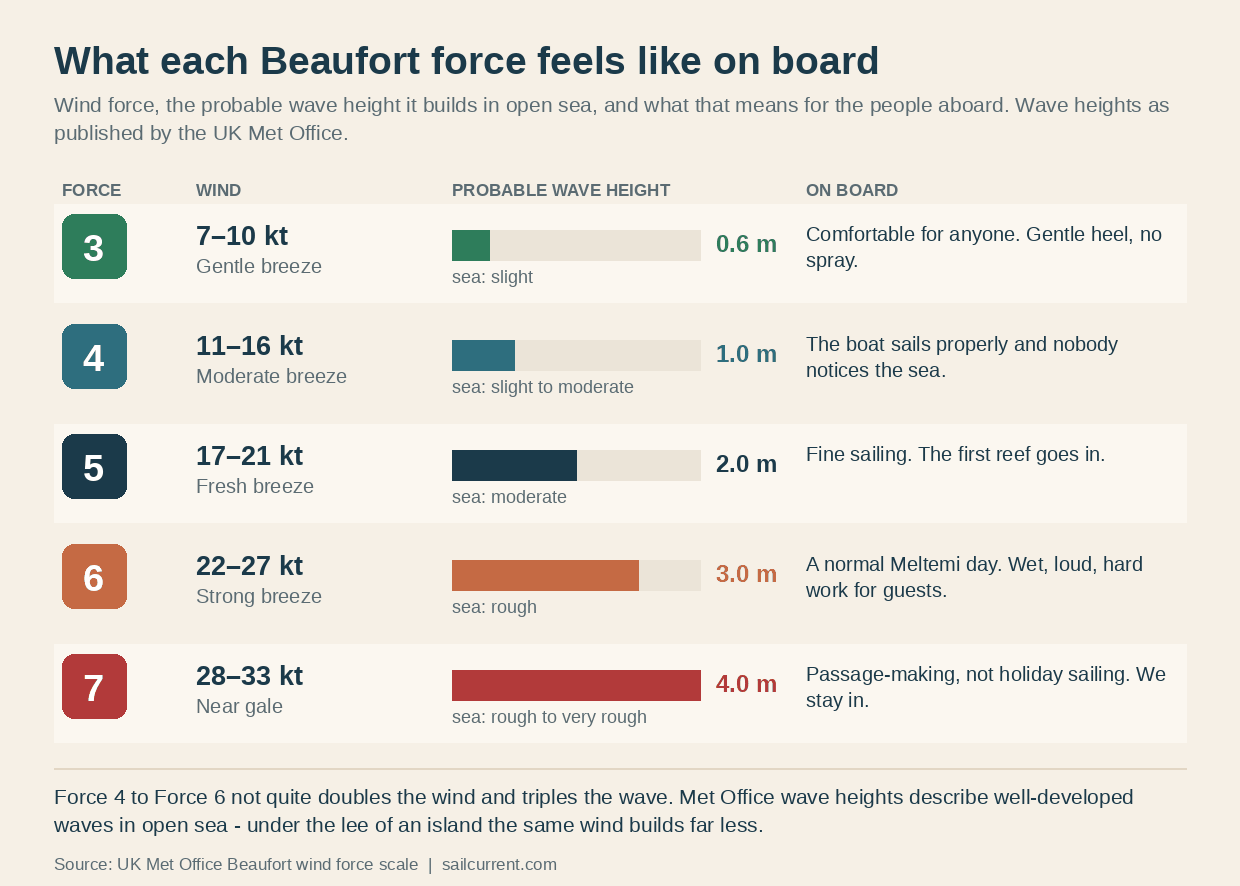
One caveat the Met Office attaches to its own table matters enormously here: those heights "refer to well-developed wind waves of the open sea", and there is a "lag effect between the wind getting up and the sea increasing". In the Cyclades you are rarely in open sea. Two miles under the lee of an island, 22 knots produces very little; the same 22 knots across an open channel produces the full three metres. Same forecast, two different days — and the difference is where the boat is.
Which force is too much with children aboard?
A judgement, not a rule, and mine is conservative. With small children on board I plan the week around Force 4 and treat Force 6 as a day in harbour. Not because a well-found charter boat cannot handle Force 6 — it can, comfortably — but because a three-metre sea is miserable for a six-year-old, and a miserable six-year-old ends the holiday for everybody.
Force 5 sits in between and depends entirely on direction. Twenty knots behind you across a short hop is fun. The same twenty on the nose for four hours is not, at any age. What it is like having a skipper on board covers how the rest of a family week actually runs.
How does a skipper route around a Meltemi week?
Three moves, in the order I use them.
Go early. The Meltemi builds through the day, so a 07:30 departure buys flat water for the crossing and turns a 22-knot afternoon into time at anchor rather than time under way. Most windy-week days are solved by having breakfast at sea instead of in harbour.
Change the shape of the route, not the destination. The Cyclades run north to south and the Meltemi is a northerly, so a week that goes south first and works back up on the tail of the blow is a different holiday from the same islands in the opposite order. Planning that is a large part of what a skipper is for.
Move the week west. If the forecast three days out has settled into a hard Meltemi block, the Saronic leaves from the same Athens base and peaks at 7.3 knots in its windiest month. The seven-day Saronic itinerary is the bad-weather plan that does not feel like one.
What I will not do is sail into it to protect a plan. A booked taverna is not a reason.
Is the Ionian really the calm option?
Yes — and the bill arrives as rain. Corfu is the calmest sailing water in Greece by a clear margin, never averaging above 4.4 knots between April and October, or 5.5 at its February peak. Kefalonia holds a steady 5.7 to 6.6 all season: flat mornings, short hops, an afternoon breeze that turns up politely and leaves again.
The trade shows up in the rainfall column, and it is sharper than most people expect. In September, Corfu records 87.8 mm of rain across 7.4 wet days. Naxos records 7.7 mm across 1.9. Eleven times the rainfall, same month, same country.
From May to August the trade is a good one — Kefalonia takes 6.0 mm across less than a single wet day in July. From mid-September it stops being good, and by October Corfu is at 140.4 mm across 11.4 days. The Ionian's calm-water advantage is real from May to early September and fades fast after that, which is the mirror image of the Aegean, where it is the wind that worsens in autumn.
One practical note: Ionian weeks start in Lefkada rather than Athens, so you fly into Preveza instead of the Athens base.
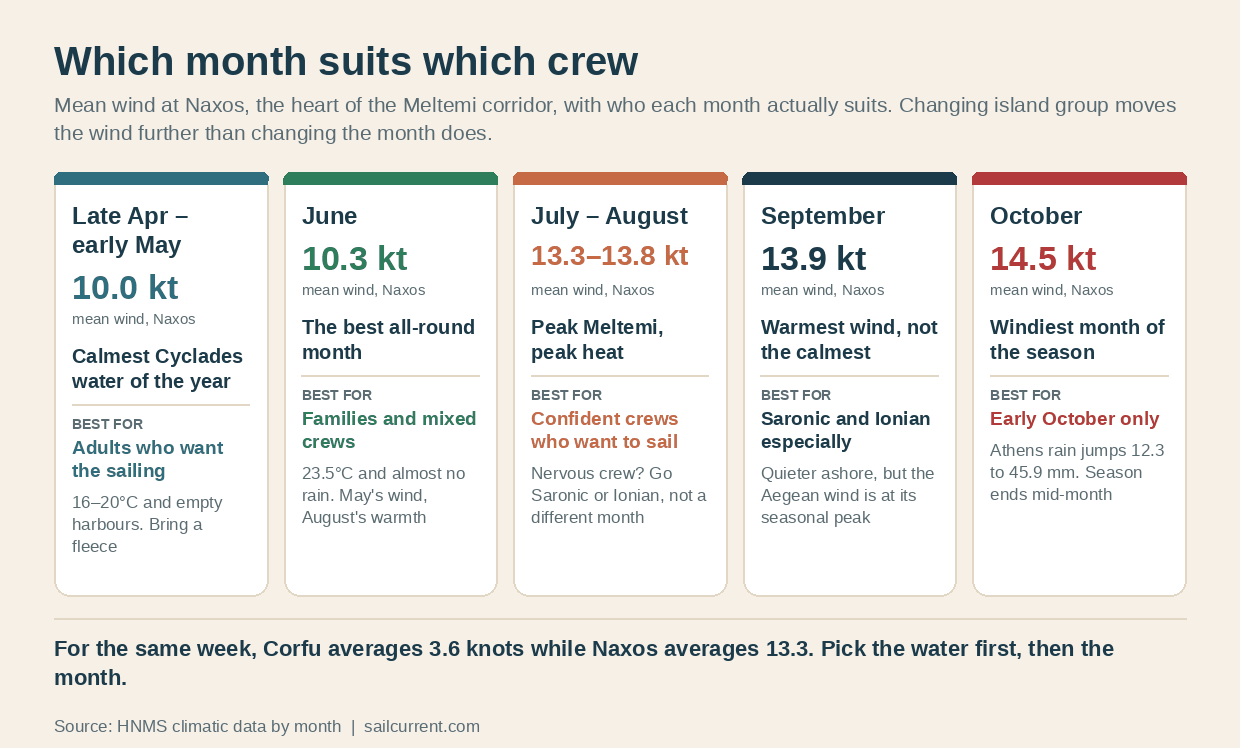
So which month should you actually book?
Late April and early May. The quietest Cyclades water of the year — Naxos at 10.0 knots — and empty harbours, but 16 to 20°C and 25.5 mm of April rain on the Athens coast. For adults who want the sailing and do not mind a fleece.
June. The month I recommend most and the one nobody markets. The Cyclades run 10.3 knots, three below July, at 23.5°C with almost no rain. May's wind with August's warmth.
July and August. Peak Meltemi, peak heat. Excellent for a confident crew that wants to sail hard. For a nervous one, this is the month to be in the Saronic or the Ionian — not the month to stay at home.
September. Warm, quieter ashore, and the Aegean wind at its seasonal peak rather than its low. A strong choice for the Saronic and the Ionian; a real sailing month, not a soft one, in the Cyclades. The shoulder-season piece covers what September does and does not change, and what a week in Greece actually costs handles the money side.
October. The windiest Cyclades month of the season, and the month the rain returns: the Athens coast goes from 12.3 mm in September to 45.9 in October. Early October still works. Late October is a different sport.
When is the Greek sailing season genuinely over?
Around the middle of October, by the met service's own definition. HNMS splits the Greek year in two: "the cold and rainy period lasting from the mid of October until the end of March, and the warm and non-rain season lasting from April until September."
The figures follow that line closely. The Athens coast holds 19.6°C through October with 45.9 mm of rain; by November it is 15.4°C and 60.1 mm. Corfu climbs from 140.4 mm in October to 187.1 in November. The wind, in the Aegean, does not fall away at all — Naxos still averages 13.2 knots in November — so the end of the season is set by rain and temperature, not by the Meltemi.
FAQ
When is the best month to sail the Greek islands?
June, for most crews. In the Cyclades it averages 10.3 knots against July's 13.3, while the air is already at 23.5°C and there is almost no rain. May is calmer still but noticeably cooler. If your crew is nervous rather than cold-averse, changing island group does more for you than changing month.
What months does the Meltemi blow?
It is a summer wind and it is strongest from July to October in the central Aegean. At Naxos the mean runs 13.3 knots in July, 13.8 in August, 13.9 in September and 14.5 in October. It usually arrives in blocks of two to four days rather than blowing continuously, and it builds through the day.
Is September a good time to sail in Greece?
It is warm and much quieter ashore, but it is not a calmer month in the Aegean — Naxos averages more wind in September than in July. September suits the Saronic and the Ionian very well. In the Cyclades it is a real sailing month rather than a gentle one.
Which Greek islands have the calmest sailing?
The Ionian, and Corfu above all: it never averages more than 4.4 knots between April and October, and 5.5 even at its February peak. Kefalonia runs 5.7 to 6.6 knots all season, and the Saronic Gulf, an hour from Athens, peaks at 7.3. All three are far calmer than the Cyclades in any month you choose.
How strong does the Meltemi actually get?
Monthly averages of 13 to 15 knots in the Cyclades mean individual days well above that, because the average already includes the calm ones. Force 6 — 22 to 27 knots, with a probable wave height of three metres — is a normal Meltemi day. Gusts typically run about a quarter above the sustained wind.
Is sailing in Greece safe with young children?
Yes, with the right water and the right planning. I plan family weeks around Force 4, where the probable wave height is about a metre, and treat Force 6 as a day in harbour. The boat could handle more; the children would not enjoy it. Choosing the Ionian or the Saronic instead of the Cyclades does most of the work on its own.
What happens if the wind is too strong to sail?
We move the plan, not the boat. Usually that means leaving earlier to cross before the wind builds, reversing the direction of the route, or spending the day in a sheltered bay or harbour. On a skippered charter that is my problem rather than yours, and it is the main reason people hire a skipper for these islands.
When does the Greek sailing season end?
Around the middle of October. Greece's national met service divides the year into a warm, dry season running from April to September and a cold, rainy one beginning in mid-October. Rainfall on the Athens coast almost quadruples between September and October, and the Aegean wind does not ease off at all.
About the author
I am Gediminas Vengrauskas, a Lithuanian licensed captain: Coastal Skipper, valid internationally for sail and motor vessels up to 24 metres and up to 12 miles offshore, by day and by night, plus ICC and a VHF radio certificate. I have been sailing for six years and I run SailCurrent on my own — skippered weeks in the Saronic, the Cyclades and the Ionian, in Dalmatia, and captain-for-hire work further afield. The boats come from licensed partner fleets. I do not own a fleet, and I would rather say so than imply otherwise.
Tell me your dates and who is coming, and I will tell you honestly which island group suits that crew — including the weeks when the answer is "not that one". Skippered sailing charters in Greece has the routes and the real rates, and if you already have a boat and need someone to run it, that is captain for hire. Either way, send me the dates and I will reply within 24 hours.
Sources checked 21 September 2026: Hellenic National Meteorological Service — climatic data by month and the climate of Greece; UK Met Office — Beaufort wind force scale and marine forecasts glossary.