Charter Security Deposits in Greece and Croatia: Waivers, Insurance and What Gets Charged
Written by Gediminas Vengrauskas, licensed Coastal Skipper · ICC · VHF. Updated October 2026
The short answer
A charter security deposit is a sum the fleet holds on your card for the week, €2,500-3,000 for a 40-49 ft monohull at Ionian Charter in Greece and €5,865 at Sunsail or The Moorings if you decline their waiver, and it is the most you pay for accidental damage. It is not the most you can ever pay: both big operators say in writing that negligence removes the cap. You can shrink the deposit with the fleet's own damage waiver, which is a fee you never get back, or keep the full deposit and insure it with a third party, which still needs the full amount free on your card.
The headline figures sit in my wider guide to what sailing in Greece actually costs. This is the detail behind them: what a fleet can keep, what the waiver costs once you do the sum, and what to check at handover so the money comes back.
Key takeaways
Ionian Charter's 2026 pricelist sets the deposit at €2,500-3,000 for most monohulls and €3,000-4,000 for most catamarans, rising to €6,000 on its six largest cats.
Sunsail and The Moorings publish one table for every base except Italy, so it covers Greece and Croatia: €5,865 for a 40-49 ft monohull without their waiver, €800 with it.
That waiver is $90 a day on the same boat. Over seven days it is about €561, and none of it comes back.
A waiver or a deposit caps accidental damage only. Negligence or reckless conduct makes you liable for the full loss.
Third-party deposit insurance does not reduce the hold on your card. Sunsail says so directly: bring your own cover and you still pay the full deposit at the base.
What is a charter security deposit, and why does it exist?
It is the part of any repair bill that the yacht's own insurance will not pay, collected from you in advance. A charter yacht carries hull insurance, and that policy has an excess. YACHT-POOL, one of the specialist charter insurers, describes the link plainly: a retained deposit "should therefore generally not exceed the excess of the comprehensive insurance", and anything bigger than that excess "must be paid by the owner's comprehensive insurance."
So the deposit is not a fee and it is not a fine. If the boat comes back as it left, you get all of it back.
At a base it is normally taken on a card before you board. Sunsail's Athens page is typical: the deposit "must be paid at the base by Visa or Master Card and is refundable at the end of your charter subject to there being no loss or damage."
How much is the security deposit in Greece and Croatia in 2026?
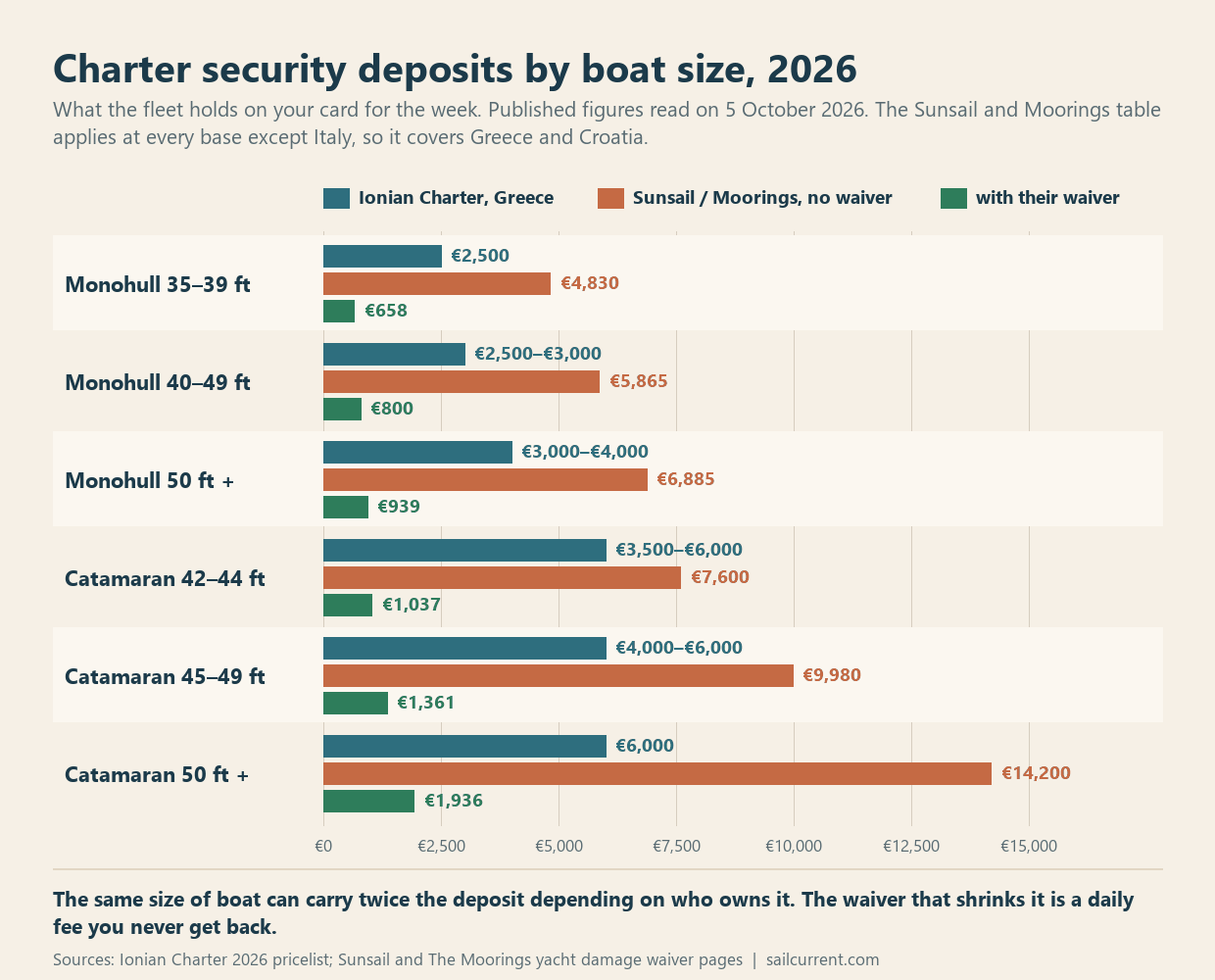
Between €2,500 and €6,000 at the Greek fleet I checked, and between €3,575 and €14,200 at the two big international operators if you decline their waiver. These are the published figures I read on 5 October 2026:
Ionian Charter (Lefkas and Athens), 2026 pricelist. Monohulls of 30-39 ft: €2,500. Monohulls of 40-49 ft: €2,500 for the smaller boats and €3,000 from about 44 ft. Monohulls over 50 ft: €3,000-4,000. Catamarans: €3,000-4,000 for most of the fleet, and "€ 6.000 Without Skipper / € 5.000 With Skipper" on six of the largest.
Sunsail and The Moorings, every base except Italy, deposit only. Monohulls: €3,575 (30-34 ft), €4,830 (35-39 ft), €5,865 (40-49 ft), €6,885 (50 ft and over). Catamarans: €5,915 (30-41 ft), €7,600 (42-44 ft), €9,980 (45-49 ft), €14,200 (50 ft and over).
Sunsail and The Moorings, with their Yacht Damage Waiver bought. The same boats drop to €487-939 for monohulls and €807-1,936 for catamarans.
Two things stand out. The same size of boat can carry twice the deposit depending on who owns it: a 45-footer is €3,000 at Ionian Charter and €5,865 at Sunsail before any waiver. And length for length, a catamaran costs more to secure than a monohull at both.
Sunsail's table covers its Croatian bases as well as its Greek ones. I have not printed a local Croatian fleet's standard deposit, because I could not read the pricelist I wanted this week and I will not quote a number I have not seen for myself.
What can the fleet actually charge against it?
Damage or loss that you or your crew caused, to the yacht and its equipment. Sunsail's wording covers "accidental damage or loss to the yacht and ancillary equipment", and it also names damage to "property belonging to a third party". In practice that means the gelcoat you scraped, the fender you left behind in Hydra and the winch handle that went over the side.
What it should not cover is the boat wearing out. YACHT-POOL draws the line between justified and unjustified retentions, and its examples of the unjustified kind are worth knowing by heart: damage "due, for example, to defective construction or material fatigue, such as tearing of the forestay without external influence, tearing of shrouds or the anchor chain". If a fitting fails under normal use, that is maintenance, and maintenance is the owner's bill.
The same insurer suggests settling two points in writing before you sign, and I think both are sensible: that the deposit is kept only for material damage your crew caused, evidenced by repair receipts, and that it is not there to settle liability claims from other people. The yacht's liability insurance comes first for those.
One more cost sits outside the deposit: the next guest's holiday, if a repair keeps the boat in harbour. YACHT-POOL sells a separate "charter consequential loss" policy for exactly this, which tells you the risk is real. Ask the fleet what its contract says.
Is my liability capped at the deposit?
For an accident, yes. For negligence, no. Sunsail and The Moorings use identical wording: you are liable "up to the value of the security deposit paid at the base, except in the case of negligence". And if the damage is caused by "your negligence or reckless conduct you will be liable for the full extent of the loss suffered and our right to claim against you will not be limited or waived in any way by the payment of the security deposit or purchase of YDW."
Neither the deposit nor the waiver is a ceiling if the fleet can show you were careless. The contract decides what counts, not me, but I would expect leaving harbour into a forecast gale, or handing the helm to someone who has had four beers, to be the kind of decision that turns a €3,000 problem into an open-ended one.
There is insurance for this gap too, and it is not deposit insurance. YACHT-POOL notes that hull insurers "fall back on the skipper for grossly negligent damage to the ship", and lists "damage to the yacht due to gross negligence" among the things its skipper liability policy covers.
What is a damage waiver, and what does it really cost?
A non-refundable fee paid to the fleet, in exchange for a much smaller deposit. Sunsail calls it "an up-front prepayment to cover any damage to the yacht" that "will not be refunded to you at the conclusion of your vacation." You still pay a deposit on top, just a lower one.
Sunsail and The Moorings price it by the day, in US dollars, for every base except Italy:
Monohull 35-39 ft: $85 a day. Deposit falls from €4,830 to €658.
Monohull 40-49 ft: $90 a day. Deposit falls from €5,865 to €800.
Catamaran 42-44 ft: $140 a day. Deposit falls from €7,600 to €1,037.
Catamaran 45-49 ft: $145 a day. Deposit falls from €9,980 to €1,361.
At the European Central Bank's reference rate of 2 October 2026 (€1 = $1.1225), seven days of waiver on a 40-49 ft monohull is $630, or about €561. On a 42-44 ft catamaran it is $980, about €873.
Croatia's Navigare Yachting, which runs a fleet out of Trogir, takes a different line. Its booking guide says the damage waiver is "optional but mandatory for all skippered charters" and that it "reduces the security deposit payable at the base". Its Lagoon 42 listing in Trogir adds that the waiver "limits your liability to the reduced Security Deposit" and is charged per night with a seven-night minimum.
Is the waiver worth it? The arithmetic
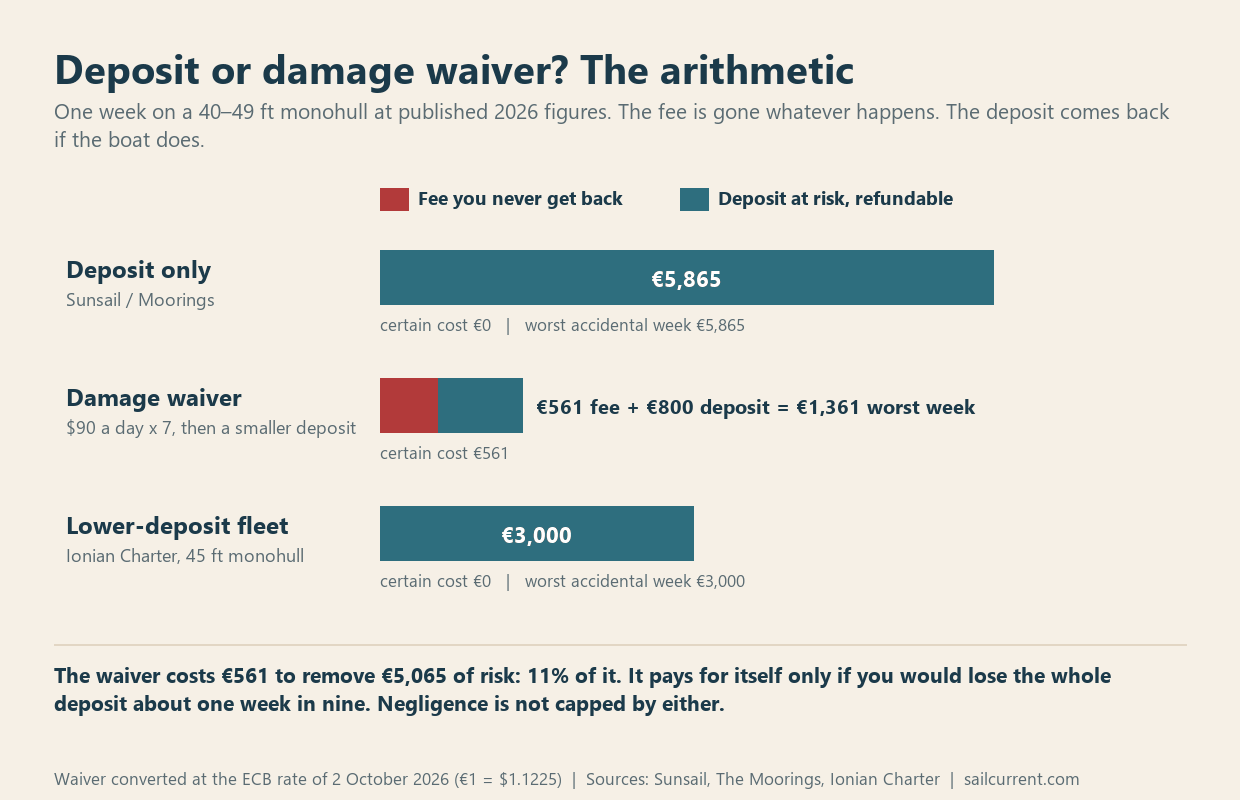
On probability alone, only if you think you have a better than one-in-nine chance of losing the whole deposit. On cash flow, whenever you cannot leave €5,865 blocked on a card. Here is the sum for a 40-49 ft monohull at Sunsail's published figures.
Without the waiver you pay nothing extra and risk €5,865. With it you pay €561 for certain and risk €800, so the worst accidental week costs €1,361. You have spent €561 to take €5,065 of risk off the table. The fee is 11% of the risk it removes, so it takes roughly one total loss in every nine charters before the waiver pays for itself.
The waiver only wins on a big loss. For a lost fender or a chipped bow costing a few hundred euros, you would have paid more for the waiver than for the accident.
The stronger argument for the waiver is cash, not probability. A deposit is a real hold on a real card. Not everyone has €5,865 of spare limit in the same week they are paying for flights, tavernas and fuel.
One quieter option: choose a fleet with a lower deposit in the first place. A 45-footer at Ionian Charter carries €3,000 with no waiver and no fee.
What is deposit insurance, and how is it different from a waiver?
It is a policy you buy from an insurer, not the fleet. You still pay the full deposit; if the fleet keeps some of it, the insurer pays you back, less an excess. Ionian Charter recommends it on its own pricelist: "We recommend to our clients to buy a private Deposit Insurance through Eis or Yacht Pool Insurance."
The differences from a waiver matter:
Who decides. With a waiver, the fleet is both the party claiming the damage and the party deciding whether its own product covers it. With insurance, a third party decides.
How long it lasts. YACHT-POOL's policy runs "for a whole year without limitation", for as many charters as you like. A waiver is bought again for every booking.
The excess. YACHT-POOL's is "only 5% of the deposit or the lower damage, at least €50". On a €3,000 deposit, that is €150 at most.
The price. Pantaenius, another specialist yacht insurer, lets you insure any deposit from €500 to €20,000 in €500 steps. Its own published example is €90.89 to cover a €1,000 deposit on an eight-day July motor-boat charter. Racing costs far more: its regatta-week example is €401.18 for €3,000. Get a quote for your own boat and dates rather than trusting anyone's rule of thumb, including mine.
The small print. Ionian Charter's pricelist carries a line that "the deposit insurance is not applicable for catamarans built 2015 - 2025". I would ask the fleet exactly which product that refers to before relying on cover for a newer cat.
Insurance does not shrink the hold on your card, and this catches people at the base. It reimburses you afterwards. Sunsail states it without decoration: "Customers who have acquired their own YDW via a third party will be required to pay the excess amounts under Option 2 upon arrival at the base." So on a 40-49 ft Sunsail monohull you still need €5,865 free on a Visa or Mastercard at check-in. If something is deducted, YACHT-POOL's instructions are specific: get "a receipt from the charter company and, if necessary, a corresponding repair invoice", and send it with "a damage report signed by all crew members".
YACHT-POOL also warns, in its own interest but not without reason, that many fleets' in-house products are "often not genuine insurance policies" and that their exclusions can include "grounding, damage to the rudder, the dinghy, scratching and scraping damage or the outboard motor". Whichever you buy, read the exclusions list before the price.
Does hiring a skipper change the deposit?
Often it lowers it, and at one fleet it makes the waiver compulsory. Three published examples:
Ionian Charter takes €1,000 less on its six largest catamarans when a skipper is aboard: €5,000 instead of €6,000.
Sunsail halves the reduced deposit for guests who have bought its waiver and either join a flotilla or prebook one of its own skippers. On a 40-49 ft monohull that is €400 instead of €800.
Navigare makes its damage waiver mandatory on every skippered charter, which caps your exposure at the reduced deposit.
A fleet that lowers the deposit when a professional is at the helm is telling you where it thinks the damage comes from. More on that in hiring a freelance skipper.
A skipper does not make the deposit disappear, though. Ask whose name is on the charter contract and whose card carries the deposit. And if you insure the deposit yourself, check the policy fits a skippered week: Pantaenius describes its charter cover as being for "the non-commercial skipper", so ask the insurer in writing whether it responds when a paid skipper is running the boat.
What should the check-in cover?
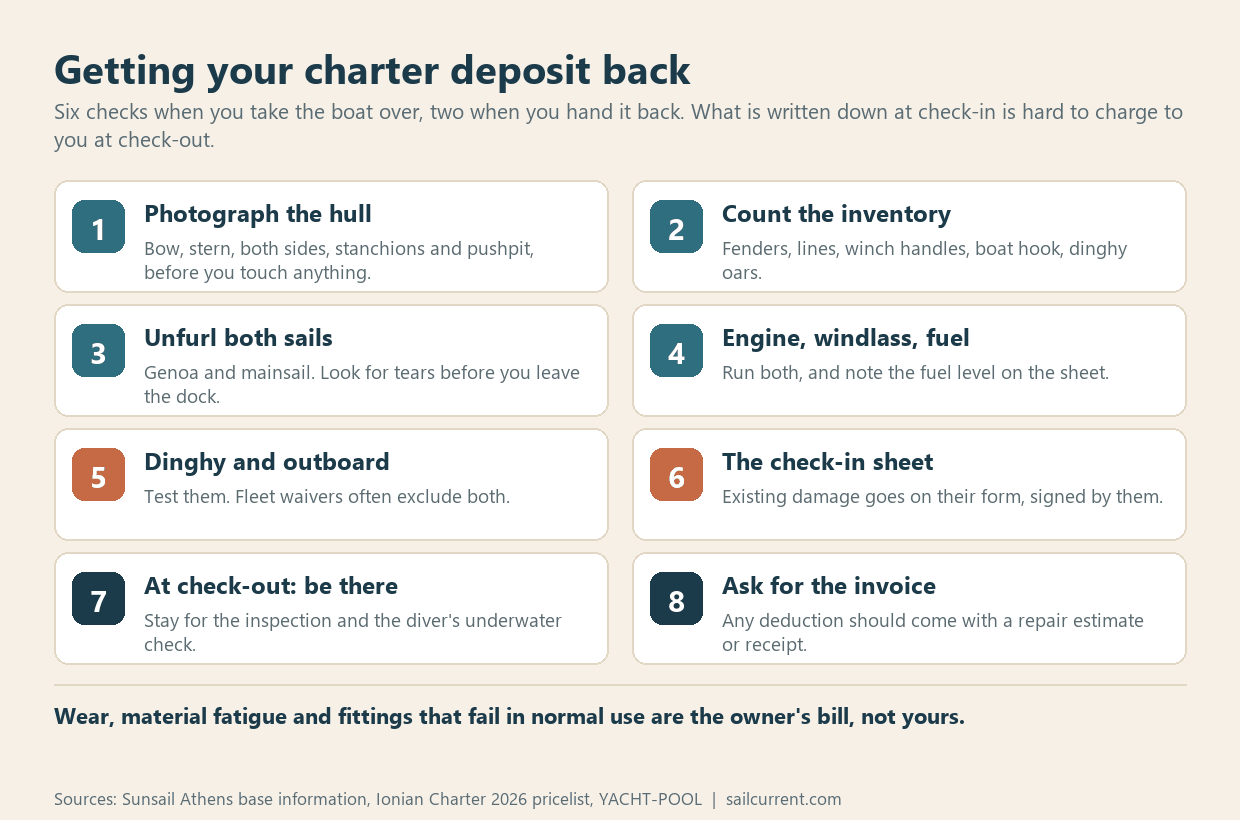
Everything you could later be charged for, seen with your own eyes and written down before you leave the dock. Sunsail makes the yacht briefing compulsory and runs it "individually for each yacht". Treat that briefing as your inspection:
Photograph the hull, the stanchions and the pushpit before you touch anything.
Count the inventory: fenders, lines, winch handles, the boat hook, the dinghy oars.
Unfurl both sails and look for tears.
Run the engine and the windlass, and note the fuel level.
Test the dinghy and outboard. YACHT-POOL names both among the things fleet waivers often exclude.
Get existing damage onto the check-in sheet. A photo on your phone helps. A line on their form, signed by them, settles it.
What happens at check-out, and when do I get the money back?
The base inspects the boat, including under the water, and releases the deposit if nothing is wrong. Sunsail's Athens base asks every yacht back "by 5:00 pm the night before disembarkation for debriefing and checks", with disembarkation at 9:00 am the next morning. Ionian Charter has a diver check every hull: "All yachts are underwater checked at the end of the charter by diver (included in the price)." That dive is where a touched keel or a nicked propeller is found, so if you did touch the bottom, say so before the diver does.
Be present for the inspection, and do not sign a damage form you disagree with before asking for the repair estimate behind it.
How fast the money returns depends on how it was taken. A pre-authorisation is released; a charge has to be refunded, and that takes as long as your bank takes. I have no published figure to give you for either, so ask the base which method it uses when you hand over the card. Note also the verb the big operators choose: the deposit "may be refunded" at the end, "subject to certain requirements being met".
What should I ask in writing before I book?
Four questions, in one email, before you pay anything.
How much is the deposit for this exact boat, and is it a pre-authorisation or a charge?
What does the damage waiver cost for my dates, what deposit remains, and what does it exclude?
Is the deposit kept only for damage my crew caused, with a repair invoice for any deduction?
Who pays if a repair makes the boat miss its next charter?
A fleet that will not put those answers in an email has already told you how check-out will go.
FAQ
How much is the security deposit on a charter yacht in Greece?
At Ionian Charter in 2026 it is €2,500-3,000 for most monohulls and €3,000-4,000 for most catamarans, rising to €6,000 on its six largest cats. Sunsail and The Moorings ask €3,575-6,885 for monohulls and €5,915-14,200 for catamarans if you do not buy their damage waiver.
Is a charter security deposit refundable?
Yes, if the boat comes back without loss or damage. Sunsail describes it as refundable at the end of the charter subject to there being no loss or damage. A damage waiver is different: that fee is never refunded.
What is the difference between a damage waiver and deposit insurance?
A damage waiver is a non-refundable fee paid to the fleet that lowers the deposit it holds. Deposit insurance is a policy from a separate insurer: you pay the full deposit, and the insurer reimburses a justified deduction afterwards, less an excess.
How much does a yacht damage waiver cost?
Sunsail and The Moorings charge $80-100 a day for monohulls and $125-170 a day for catamarans at every base except Italy. On a 40-49 ft monohull that is $90 a day, about €561 for a week at the ECB rate of 2 October 2026.
Can I lose more than the security deposit?
Yes. The deposit caps your liability for accidental damage only. Sunsail and The Moorings both state that damage caused by negligence or reckless conduct makes you liable for the full loss, whether or not you paid a deposit or bought a waiver.
Does deposit insurance reduce the amount held on my card?
No. Insurance pays you back after a deduction; it does not change what the base takes. Sunsail says guests with third-party cover must still pay the full deposit on arrival.
Does hiring a skipper lower the security deposit?
Sometimes. Ionian Charter takes €1,000 less on six large catamarans with a skipper aboard, and Sunsail halves the reduced deposit for waiver customers who prebook its skipper. Navigare makes its damage waiver mandatory on skippered charters.
What can a charter company deduct from my deposit?
Damage or loss to the yacht and its equipment that you or your crew caused. Wear, material fatigue and fittings that fail under normal use are the owner's responsibility, and any deduction should be backed by a repair invoice.
About the author
I am Gediminas Vengrauskas, a Lithuanian licensed captain: Coastal Skipper, valid internationally for sail and motor vessels up to 24 metres and up to 12 miles offshore, plus ICC and a VHF radio certificate. I have been sailing for six years and I run SailCurrent on my own. The boats come from licensed partner fleets. I do not own a fleet, so the deposit on your week is set by the fleet, not by me, and I would rather explain it before you book than at the dock.
If you want a skipper for a boat you have already chartered, captain for hire sets out my rates. If you have not chosen a boat yet, start with skippered sailing charters in Greece or skippered sailing charters in Croatia. Either way, send me the dates and I will reply within 24 hours.
Sources checked 5 October 2026: Ionian Charter 2026 pricelist; Sunsail, yacht damage waiver and security deposits; The Moorings, yacht damage waiver; YACHT-POOL charter deposit insurance; Pantaenius charter insurance; Navigare Yachting booking process; Sunsail Athens base information; ECB euro reference rates.