Written by Gediminas Vengrauskas, licensed Coastal Skipper · ICC · VHF. Updated November 2026
The short answer
A private skipper for the Saronic Gulf means one licensed skipper sailing a boat for your group alone, for a week from Athens, at €1,500 a week from April to June and in September and October, or €1,750 a week in July and August. That is my 2027 fee, the same on a catamaran or a sailing yacht, with my travel to Athens included. The boat comes separately from a licensed charter fleet, usually at Alimos Marina, which Greece's state asset fund describes as the largest marina in Greece and the Balkans.
The Saronic is one of the two sailing areas I know best, and it is the one I suggest first to crews who have never sailed. The islands sit close together, the first harbour is a morning's sail from the marina, and if the weather changes the plan, there is always another harbour within reach. Below: what a private skipper does on a Saronic week, how it compares with the other ways to see these islands, two extras most people don't know about, and what the week costs.
Key takeaways
My 2027 fee: €1,500 a week (April–June, September, October), €1,750 in July and August. Same on a catamaran or a monohull; travel to Athens included.
"Private" means your group only: your boat, your route, your pace. No other crews, no fixed programme.
Saronic hops are short. Measured on the chart, Alimos to Aegina is about 18 nautical miles and Poros to Hydra about 12.
The skipper's real work is the decisions: which harbour, which anchorage, what time to arrive, when to stay put.
A week can include a play in the ancient Little Theatre at Palea Epidavros, a ten-minute walk from the harbour.
For six guests on a four-cabin yacht, boat plus skipper comes to about €950–1,375 a person before running costs and food.
What does "a private skipper" mean in the Saronic?
It means the boat, the skipper and the week are yours alone. You charter a yacht or a catamaran from a licensed fleet, I skipper it, and nobody else joins: no strangers in the next cabin, no lead boat setting the day's destination, no fixed timetable.
Everything else follows from that. We agree the route before you fly, around your crew and the forecast, and we change it on board whenever the crew wants a longer swim or a quieter night. You can help with the sails and the lines as much as you like, or not at all. I handle the passages, the anchoring, the harbour manoeuvres and the weather calls.
I own no fleet. The boat comes from a partner charter company on the fleet's own contract, and I help you with that contract from the first email to the check-out. If you are still choosing a boat, my page of 2027 catamaran prices with a skipper lists the boats I would charter myself from Athens.
Why is the Saronic a good first week with a skipper?
Because nothing on it is far. On a typical first-week route, measured on the chart along the shortest safe line, the legs run like this: Alimos to Aegina about 18 nautical miles, Aegina to Agistri about 4, Poros to Hydra about 12, Hydra to Spetses about 16. Most days are two to four hours under sail, with the afternoon free.
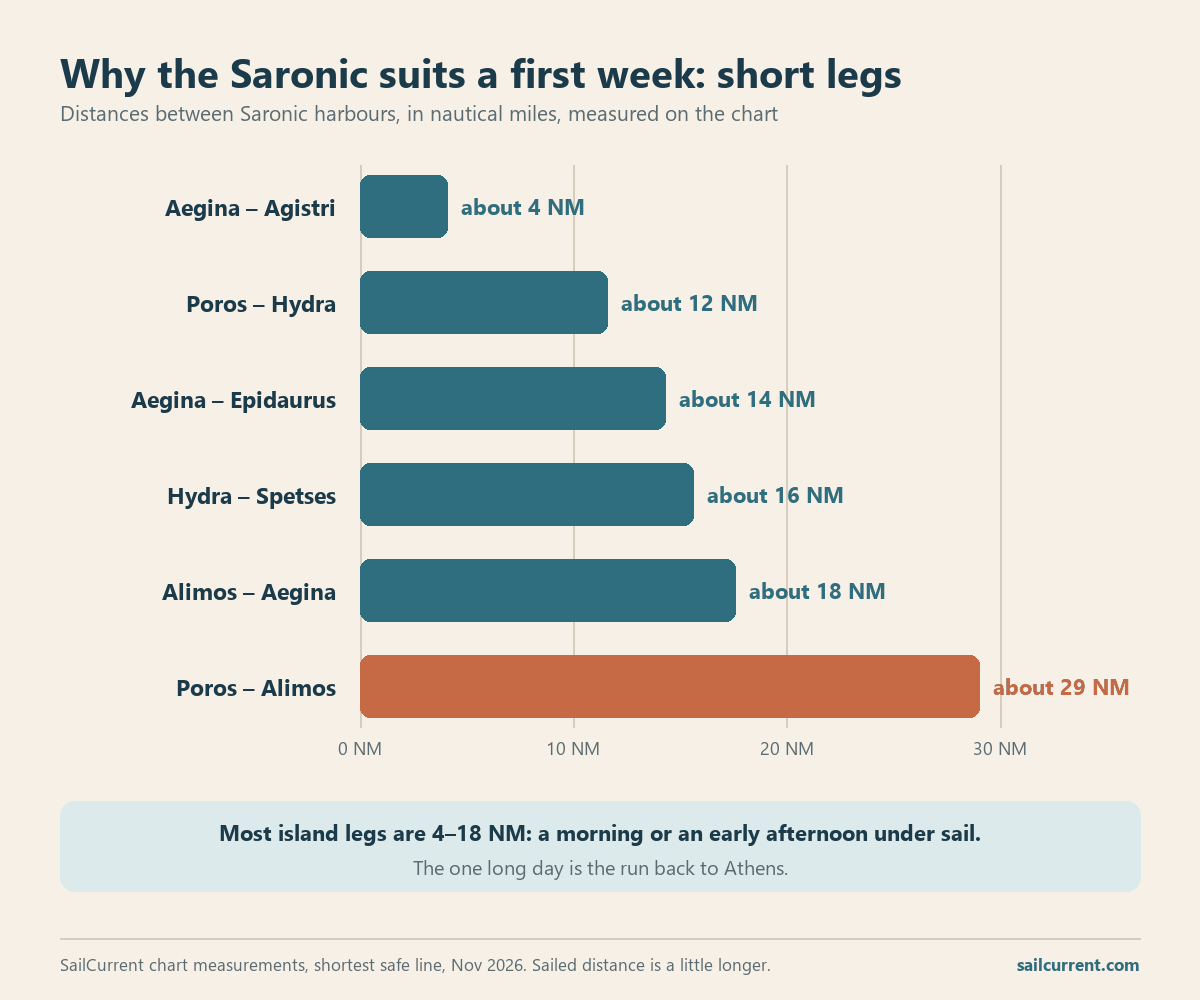
Short legs are what make a private week relaxed rather than a delivery. They leave time for a long lunch at anchor and a walk ashore, and they leave room in the plan. If the wind blows from an awkward direction, there is usually another island, or the other side of the same island, within a morning's sail.
The Saronic is also close to everything else. Alimos is on the Athens coast, so there is no ferry or long transfer between your flight and the boat. The day-by-day route I recommend, with all the distances, is in my 7-day Saronic Gulf itinerary; this post is about the skipper, not the route.
What does the skipper actually do on a Saronic week?
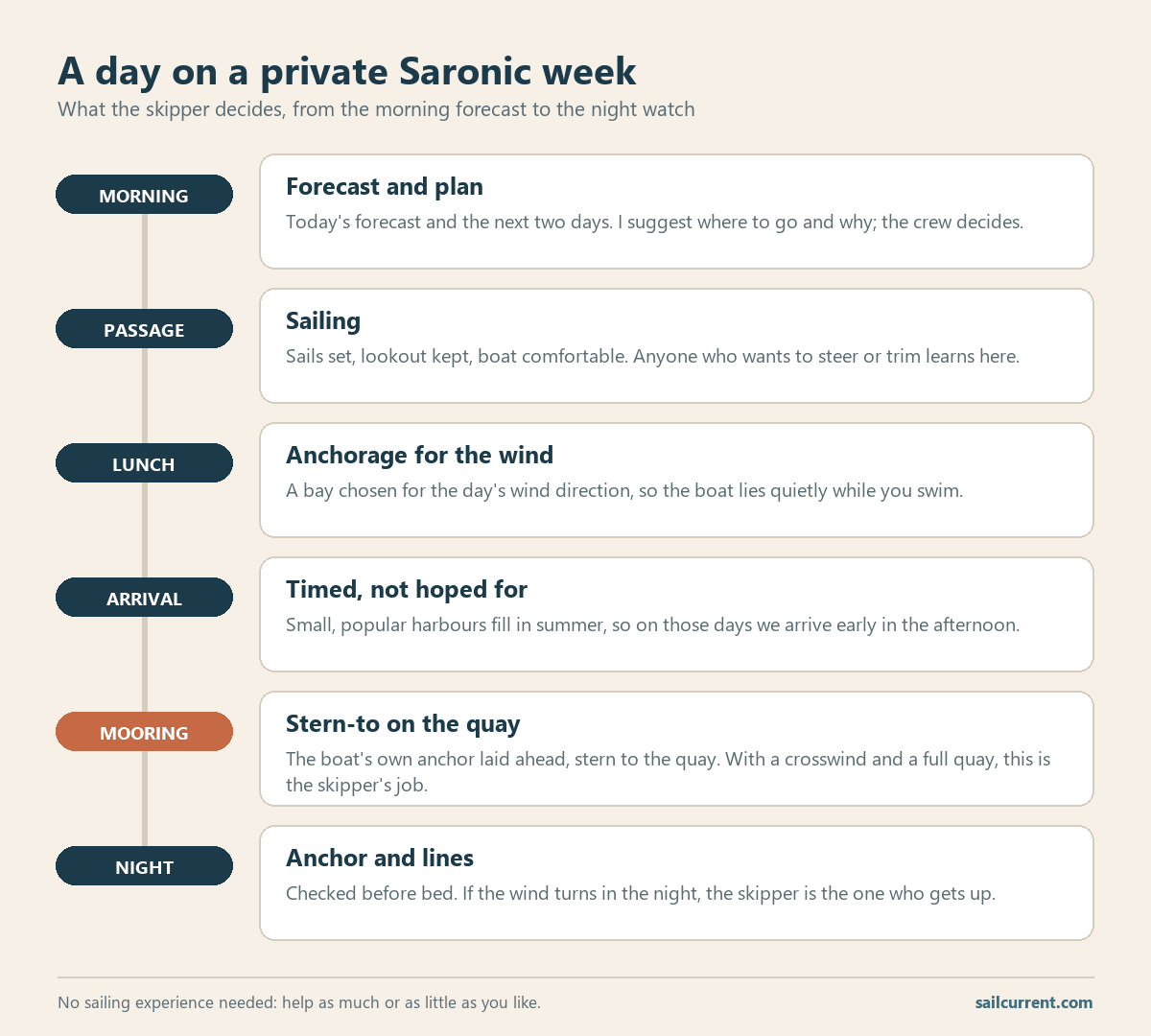
The sailing is the easy part. The job is the decisions. A typical day on a private week looks like this:
Morning: I read the forecast for the day and the next two, then suggest where to go and why. If the crew wants something different, I tell you whether it works and what it costs in time.
The passage: I set the sails, keep a lookout and keep the boat comfortable. If anyone wants to steer or trim, now is the time to learn.
Lunch: an anchorage chosen for the wind of the day, so the boat lies quietly while you swim.
Arrival: I time it. Small, popular harbours fill up in summer, so on those days we arrive early in the afternoon rather than at sunset.
Mooring: most Greek town quays are stern-to, with the boat's own anchor laid out ahead. That manoeuvre, with a crosswind and a full quay, is where a skipper earns the fee.
Night: I check the anchor and the lines, and if the wind turns, I am the one who gets up.
None of this needs you to know anything about sailing. If you would like a clearer picture of life on board, from cabins to meals, read what it's like having a skipper on board.
Private skipper, cabin charter, flotilla or day cruise?
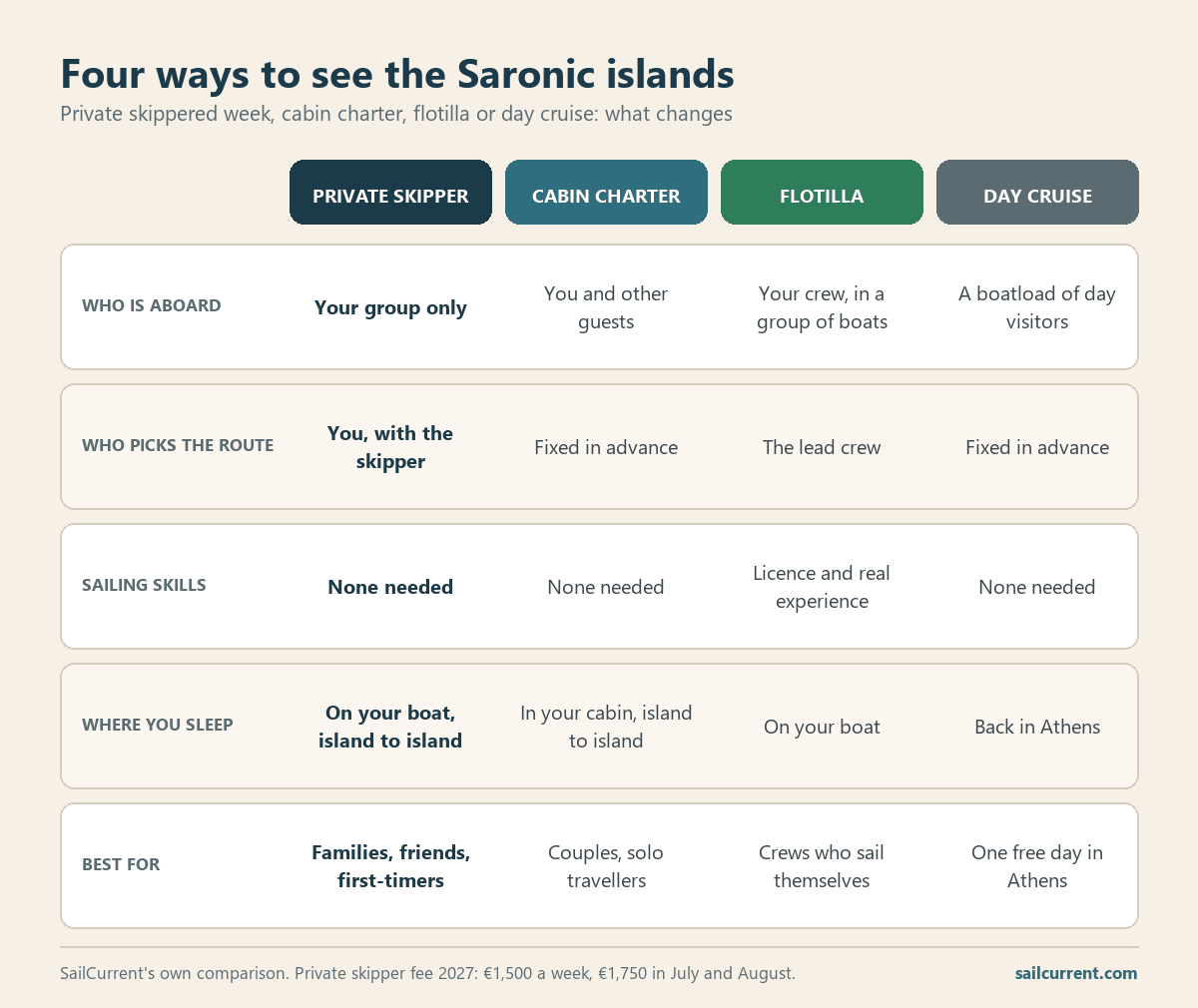
They are four different holidays, and the private skipper is the only one where the route is yours. Here is how I would choose between them:
Private skippered week: your group alone on your boat, the route planned around you, a licensed skipper on board. The best fit for families, friends and first-timers who want the islands without learning to sail first.
Cabin charter: you book a cabin, not the boat, and share it with other guests on a fixed route with a crew. Good for couples and solo travellers; you give up choosing the company and the pace.
Flotilla: you skipper your own boat inside a group led by a lead crew. You need a licence and real sailing experience, and the day's destination is the group's.
Day cruise: a ferry-style boat tour from Athens to a few islands and back in a day. Easy, but you see the islands for an hour or two each and sleep in the city.
If you are weighing these up more broadly, my comparison of skippered, bareboat, flotilla and cabin charters goes through each in detail. And if someone in your group holds a licence and you are tempted to go bareboat, read do you need a licence to charter a boat in Greece first.
Can a Saronic week include a play at ancient Epidaurus?
Yes, and from a boat it is easier than from Athens. The Athens Epidaurus Festival uses two ancient theatres in Argolis, on the Peloponnese side of the Saronic Gulf. The Little Theatre of Ancient Epidaurus stands in the village of Palea Epidavros, and the festival says its parking at the harbour is a ten-minute walk from the theatre. It was the theatre of the ancient city of Epidaurus, built in the 4th century BC, and seats some 2,000 people.
The famous Ancient Theatre of Epidaurus is a different site, inland, within the Sanctuary of Asklepios. By road the festival puts both theatres about two hours from Athens. From the harbour at Palea Epidavros the Little Theatre is a short walk; the big theatre needs a taxi.
A few house rules from the festival are worth knowing before you plan around a performance: children under six are not admitted, latecomers wait for the interval, and heels are not allowed. The festival publishes its summer programme each year. If a performance falls in your week, I plan the route so that we spend that night in Palea Epidavros.
Can we go through the Corinth Canal on a Saronic week?
It is possible, but it belongs to a different week. The canal's eastern end opens into the Saronic Gulf at Isthmia, where the canal company takes payment, and the crossing itself takes about 40 minutes between cliffs that rise up to 80 metres. The transit fee depends on the boat, and the canal company points skippers to its online fee calculator for the exact figure.
The catch is the geography. The canal leads out of the Saronic into the Gulf of Corinth, so a transit turns a relaxed island week into a passage-making week, and you would cross twice to bring the boat back to Athens. Before planning it, check that the fleet's contract allows the boat outside the Saronic. For most first-time crews I would rather spend those hours swimming off Agistri.
How much does a private skipper for the Saronic cost?
My fee is €1,500 or €1,750 a week, and for six guests the boat and skipper together come to about €950–1,375 a person. I built that range from a published price list, not a guess.
Ionian Charter, which runs a base in Athens as well as Lefkas, lists a four-cabin Jeanneau Sun Odyssey 440 at €4,200–6,500 a week across its 2026 season. Add my fee and the week runs from €5,700 (a low-season boat with my €1,500 fee) to €8,250 (a peak-season boat with my €1,750 fee). Split six ways, that is €950–1,375 each.
On top come the running costs, the end cleaning and the food. Fuel, water, harbour fees and port taxes come from a kitty the group gives me on arrival: the amount per guest is in your quote, I keep every receipt, and anything left is returned on the last day. My guide to what a skippered sailing holiday in Greece costs adds every line up, and hiring a skipper in Athens explains exactly what my fee covers.
Why six guests and not eight? Because the skipper sleeps aboard and needs a cabin of his own, so on a four-cabin boat one cabin is mine. On a larger catamaran there is room for more of you.
Does the weather ever cancel a Saronic week?
Weather changes the route, not the booking. I plan every day around the forecast and choose sheltered alternatives when they are needed, which in the Saronic usually means a different harbour or a day at anchor rather than a lost day. That rule is written into my booking terms.
If you are wondering how much wind is too much for your crew, my guide to what Beaufort Force 4, 5 and 6 feel like on a charter yacht puts it in plain terms, and the best time to sail the Greek islands goes through the season month by month.
How do you book a private skipper for the Saronic?
Tell me your dates and your crew, and I come back with a route, a boat and one written quote. The quote has three lines: the boat, paid to the fleet on its own contract; my fee, paid to me; and the kitty for the running costs. Nothing is paid until the dates and the quote are in writing.
Book early for July and August: the end of January is my rule of thumb. My own weeks are agreed in advance, and the weeks of 2027 that are already taken are listed on my Hire a Captain page. If yours is one of them, I can still plan your week and book the boat with the fleet's own skipper.
FAQ
How much does a private skipper for the Saronic Gulf cost?
My fee is €1,500 a week from April to June and in September and October, and €1,750 a week in July and August, the same on a catamaran or a monohull. My travel to Athens is included. The boat is paid separately to the charter fleet.
Where does a private Saronic week start?
Usually at Alimos Marina on the Athens coast, the largest marina in Greece. The first island, Aegina, is about 18 nautical miles away, a morning's sail.
Do we need any sailing experience?
No. I handle the passages, the anchoring, the mooring and the weather calls. You can help with the sails and the lines as much or as little as you like.
How many people can come?
Up to 12 people under my licence, but the cabins decide the real number. The skipper needs a cabin of his own, so a four-cabin yacht takes six guests comfortably.
How far apart are the Saronic islands?
Close. Measured on the chart, Aegina to Agistri is about 4 nautical miles, Poros to Hydra about 12 and Hydra to Spetses about 16, so most days are two to four hours under sail.
Can we see a play at Epidaurus during the week?
Yes. The Little Theatre of Ancient Epidaurus is a ten-minute walk from the harbour at Palea Epidavros, so we can moor there for the night of a performance. Children under six are not admitted.
Can we sail through the Corinth Canal?
It is possible, but it leads out of the Saronic into the Gulf of Corinth, so it suits a passage-making week rather than an island week. The fee depends on the boat, and the fleet's contract has to allow the trip.
What happens if the weather is bad?
The route changes, not the booking. I plan every day around the forecast and pick a sheltered harbour or anchorage when the wind needs it.
About the author
I am Gediminas Vengrauskas, a Lithuanian skipper with six years of sailing and about 1,000 nautical miles logged. I hold an international Coastal Skipper certificate for sail and motor vessels up to 24 metres, day and night, up to 12 miles offshore, plus an ICC, a VHF radio operator's certificate and a 2026 first-aid certificate. The waters I know best are the Saronic Gulf and Dalmatia, plus the Baltic. Every charter I skipper is covered by professional skipper liability insurance, in place before we sail.
Planning a Saronic week?
Send me your dates, your crew and how much sailing you would like through the contact form, or read the full details on my skippered sailing charters in Greece page. I reply within 24 hours.
Sources checked November 2026: Greece's state asset fund (Growthfund) on Alimos Marina; the Athens Epidaurus Festival's venue pages for the Little Theatre and the Ancient Theatre of Epidaurus; the Corinth Canal company's yachting and FAQ pages; Ionian Charter's 2026 price list and Saronic Gulf page; my own booking terms. Distances measured on the chart along the shortest safe line.
